
Have you ever entered a salon and felt instantly relaxed—or, conversely, tense and uneasy? Have you noticed how some beauty beds look warm and inviting, while others appear cold or sterile?
It’s not just about aesthetics. Scientific research confirms that light—its color, brightness, and placement—directly affects human emotion, perception, and even physiological responses. Poor lighting can make clients feel uncomfortable, reduce perceived service quality, and negatively impact their overall experience. On the other hand, thoughtfully designed LED lighting can enhance relaxation, improve esthetician efficiency, and elevate client satisfaction.
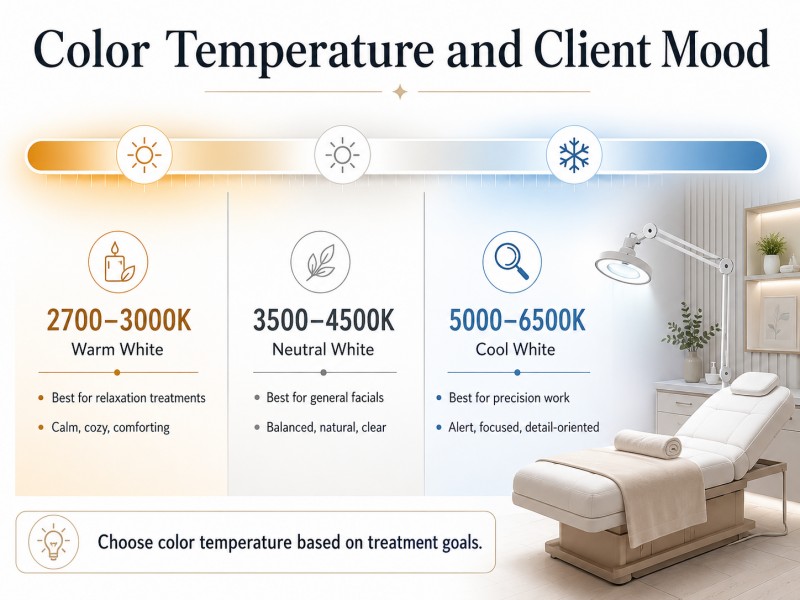
Observation: Many salons use standard white LEDs for all treatments, but clients may perceive cold or overly bright environments as stressful.
Scientific Principle: Color temperature, measured in Kelvin (K), affects mood:
| Color Temperature | Typical Use | Psychological Effect |
|---|---|---|
| 2700–3000K | Relaxation, massage, sensory treatments | Warm, cozy, calming |
| 3500–4500K | Facials, skin analysis, makeup | Balanced, accurate color perception |
| 5000–6500K | Precision tasks | Alertness, focus, enhanced detail perception |
Evidence: Warm lighting increases perceived comfort, whereas cool light improves task performance (CIR Japan).
Actionable Tip: Invest in adjustable LED beauty beds that allow color temperature changes according to treatment type.
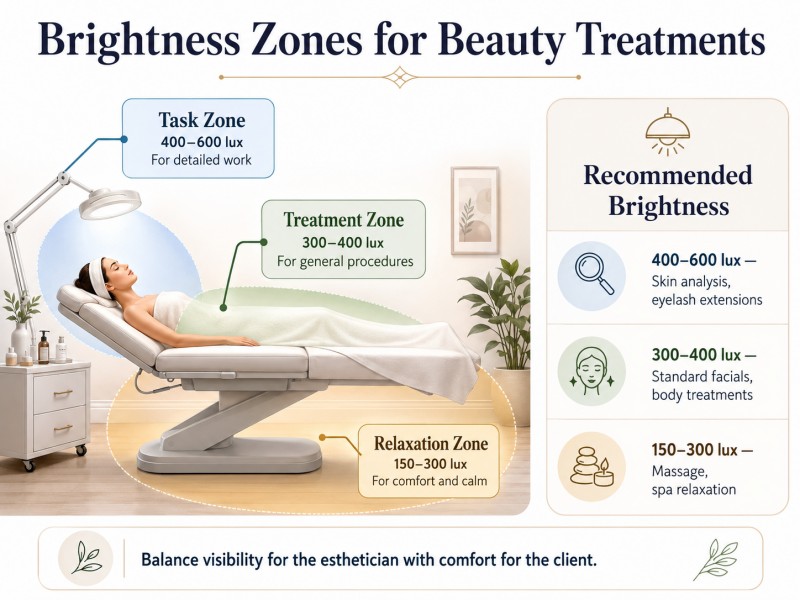
Brightness (measured in lux) significantly affects both client comfort and esthetician efficiency. Research shows that:
High brightness (>400 lux) improves precision and accuracy for detailed tasks
Medium brightness (300–400 lux) supports standard facial and body treatments
Low brightness (<300 lux) promotes relaxation and privacy (Scientific Reports)
Implementation Suggestion: Use multi-zone LED control to adjust brightness at head, torso, and leg areas independently, allowing flexibility across treatment steps.
Yes. Studies using the Mehrabian–Russell emotional model show that colored lighting significantly impacts pleasure and arousal:
Blue light: Calming, promotes relaxation
Green light: Eye comfort, neutral balance
Red light: Arousing, may increase tension or alertness (SAGE Journals)
Application:
RGB LED strips enable dynamic color changes to match treatment type, brand identity, or marketing theme.
Soft blue or green can enhance spa relaxation; warm orange or amber may make treatments feel cozier.
Certain LED wavelengths affect the circadian rhythm and hormone regulation, including melatonin and cortisol levels. Exposure to blue-rich light can increase alertness, while warm light in the evening supports relaxation (Scientific Reports).
Implication: Properly tuned LED lighting can enhance client physiological comfort, creating a more restorative spa experience.
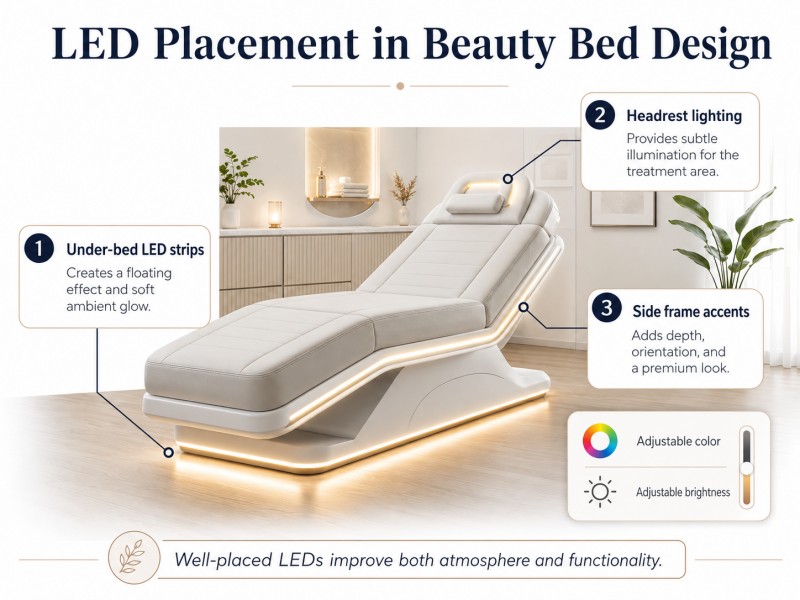
Yes. Environmental design research shows that indirect lighting reduces glare and visual fatigue, while targeted illumination enhances perception and focus.
Recommended LED placements:
Under-bed strips: Creates a floating, luxurious effect, softens shadows
Headrest LEDs: Illuminates treatment areas subtly
Side-frame LEDs: Highlights space, guides movement safely
Pro Tip: Integrate LED lighting with motorized bed adjustments so illumination remains consistent as the bed tilts or rotates.
A high-end spa integrated RGB LED strips into adjustable beauty beds:
35% increase in client satisfaction for ambiance
Faster lighting setup for estheticians
Enhanced social media engagement, leading to brand exposure
Conclusion: LED lighting is both functional and marketing-friendly—it enhances client experience and improves operational efficiency.
Adjustable color temperature LEDs: Align lighting with treatment type
Multi-zone brightness control: Optimize for client comfort and esthetician visibility
RGB mood lighting: Support relaxation and social media aesthetics
Consider physiological effects: Ensure circadian-friendly lighting for longer treatments
Energy-efficient LEDs: Reduce heat, maintenance, and operational costs
Integration with smart systems: Automated lighting adjustments based on treatment type or client profile
Personalized lighting experiences: Apps or controls that allow clients to select preferred ambiance
Combination with aromatherapy and soundscapes: Multi-sensory experience design
Forward-thinking salons are now combining LED lighting with technology and design to create fully immersive experiences.
LED lighting in beauty bed design is far more than decoration. Thoughtful design of color, brightness, and placement influences client mood, perception of service quality, and physiological comfort. For salon owners, integrating science-backed LED systems can elevate the overall spa experience, increase satisfaction, and enhance brand differentiation.
Effects of illuminance and correlated color temperature on emotion perception — Scientific Reports (Nature)
Effects of LED color temperature and illuminance on customers’ emotional states — CIR Japan (cir.nii.ac.jp)
Effects of coloured lighting on pleasure and arousal — SAGE Journals (journals.sagepub.com)
Non-visual effects of light on human circadian rhythms — Scientific Reports (Nature)


"*" indicates required fields


