
When buyers compare electric beauty beds, they usually look first at the number of motors, height adjustment, upholstery, weight capacity and overall appearance.
The base is often treated as a visual detail.
For the technician, however, the base can have a direct effect on how close they can sit or stand to the client.
During facials, lash services, brow treatments, permanent makeup and other precision work, technicians frequently work from the head or side of the bed. If a wide pedestal, crossbar or lifting structure blocks the knees or feet, the technician may have to sit farther away and lean forward to reach the treatment area.
That difference may seem small during a short demonstration. Over several hours of appointments, it can significantly affect working posture and comfort.
NIOSH identifies awkward and prolonged postures—including bending, twisting and sustained reaching—as workplace ergonomic risk factors. Work equipment and workstation layout should therefore be designed to fit the worker rather than forcing the worker to adapt to the equipment.
Different treatments place the technician in different positions around the bed.
For example:
Facial treatments often require access from the head and both sides.
Lash extensions may keep the technician seated at the head of the bed for long periods.
Brow and PMU work require close visual access to the client’s face.
Waxing involves frequent movement between the side and foot areas.
Body treatments may require the technician to move along almost the entire bed.
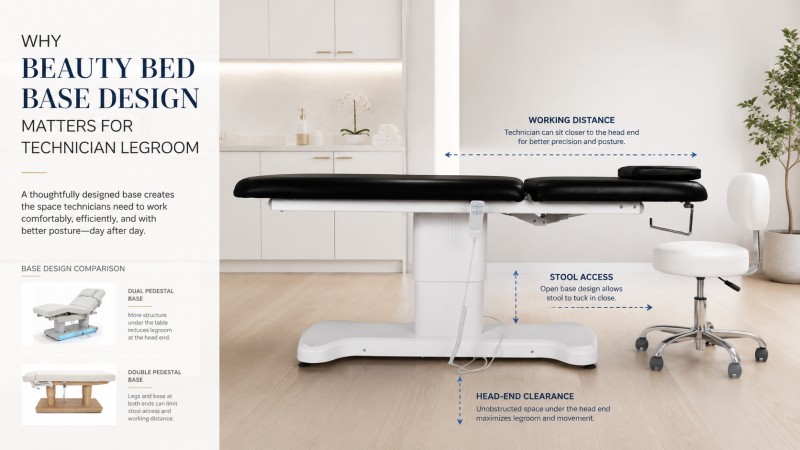
The closer the technician can position their stool and knees to the working area, the easier it is to keep the elbows closer to the body and avoid excessive forward reaching.
OSHA notes that sufficient clearance beneath a workstation allows users to adopt more natural working positions, while restricted clearance can contribute to awkward postures. Although this guidance is written for computer workstations, the same basic ergonomic principle applies to treatment furniture: equipment should not unnecessarily block the operator’s lower body.
A large base extending close to the outer edge of the cushion can prevent the technician from moving a stool underneath the bed.
This may cause the technician to:
Sit farther from the client
Lean forward from the waist
Round the shoulders
Stretch the arms forward
Turn the body instead of moving closer
Keep the knees spread around the base
The problem is particularly noticeable during detailed facial work.
This is why the overall bed width alone does not tell you whether a bed offers good working access.
Two beds can both measure 75 cm wide while having completely different amounts of usable knee space underneath.
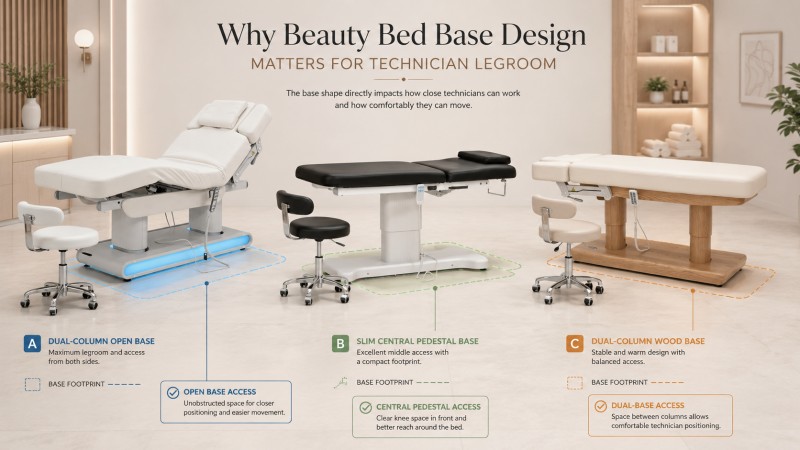
There is no single base design that is best for every salon. Each structure balances stability, appearance, lifting method, storage and technician access differently.
A narrow central pedestal leaves more open space around the perimeter of the bed.
This type of structure is especially useful when the technician frequently sits near the head or sides.
Dongpin's DP-Z041 is an example of a single-column spa bed design. Dongpin describes the model as using a slim base intended to maintain a clean appearance while leaving more working space around the bed.
Single-column designs can work well for:
Facial studios
Skin clinics
Lash and brow treatments
Precision aesthetic services
Smaller treatment rooms
The technician can often position their stool closer because the base does not extend as far toward the outer cushion edges.
Vertical-lift designs move primarily upward and downward instead of shifting the bed sideways as height changes.
The DP-L236, for example, uses a vertical lifting structure with a three-motor system. Dongpin states that the vertical design avoids lateral displacement during height adjustments and helps optimize space efficiency.
This matters because a bed that shifts horizontally while rising can change the technician’s position relative to:
Walls
Cabinets
Trolleys
Stools
Treatment machines
A vertical lift keeps the working footprint more predictable.
However, buyers should still inspect the width and shape of the lower pedestal. Vertical lifting alone does not guarantee unlimited knee clearance.
A wide enclosed base can provide a solid appearance and conceal motors, cables and lifting mechanisms.
Models such as the Dongpin 8197 use an enclosed acrylic-style base while providing four-motor adjustment and an overall tilt function of up to 20°.
This structure can work well in:
Medical spas
Multifunction treatment rooms
Clinics prioritizing a clean equipment appearance
Treatments performed mostly from standing positions
The trade-off is that a wider base may occupy some of the space where a seated technician would otherwise place their feet or knees.
That does not automatically make it a poor design. It simply means leg clearance should be evaluated against the actual treatment workflow.
Some beds expose more of the lifting structure instead of enclosing it completely.
An open structure can create additional space between the base and mattress platform, but brackets, actuators and cross-members can still interfere with knee placement.
The important question is not whether the base is visually “open” or “closed.”
The question is:
Where can the technician physically place their knees and feet while working?
Good legroom cannot compensate for the wrong working height.
Likewise, excellent height adjustment cannot solve a base that prevents the technician from getting close enough to the client.
Both need to work together.
The goal is to allow the technician to position the treatment area at a comfortable working height while keeping their body close to the bed.
An electric beauty bed allows technicians of different heights to adjust the client instead of adjusting their own posture.
For example, the DP-L236 adjusts vertically from approximately 58 to 80 cm and supports independent backrest and leg-rest adjustment.
The DP-EB103 provides a height range of 62–87 cm and uses a three-motor system with foot-control options for hands-free adjustment.
This is particularly useful in salons with multiple technicians because one fixed bed height rarely suits everyone.
Buyers often compare:
“Which bed goes lower?”
That matters for client entry and some procedures, but technician ergonomics depend on more than minimum height.
You should also check:
Maximum working height
Vertical vs. lateral lifting movement
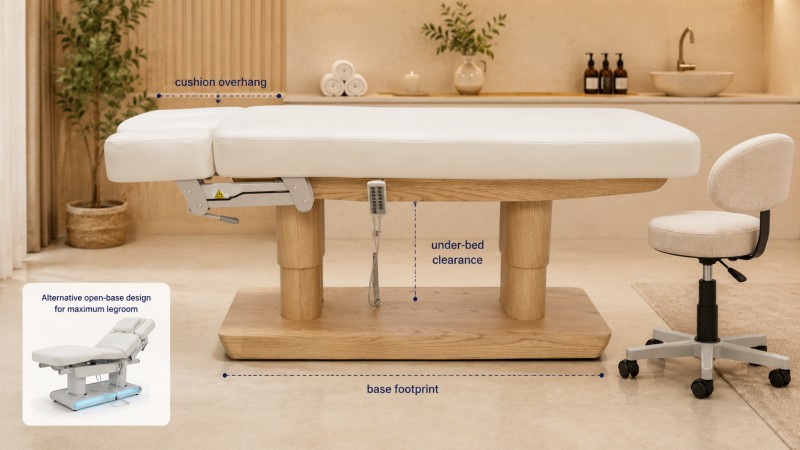
Clearance below the cushion
Base width
Base length
Head-end clearance
Side clearance
A taller technician may need the bed significantly higher than a shorter technician, especially during standing treatments.
If there is one area buyers should inspect carefully, it is the head end.
Facialists, lash technicians and PMU artists often spend long periods positioned directly behind the client's head.
Ideally, a rolling technician stool should be able to approach the head end without the user’s knees immediately contacting the base.
A simple product photo from the front may not reveal this.
Before ordering, request:
Full side-view photos
Head-end photos
Base dimensions
Distance from mattress edge to base edge
Video showing a technician stool positioned around the bed
If possible, test the bed with the same type of stool used in the salon.
One useful design feature is the amount of mattress platform extending beyond the base.
A reasonable overhang can create a “working pocket” where the technician’s knees sit beneath the client without touching the pedestal.
The exact amount required depends on:
Technician height
Stool size
Treatment type
Cushion width
Bed height
There is no universal ideal measurement.
That is why actual clearance is more useful than simply comparing catalog dimensions.
A bed should be selected around the services performed most often.
Prioritize:
Head-end clearance
Narrow or centralized base
Electric height adjustment
Stool access
Smooth backrest control
The DP-Z041's single-column structure is one example suited to treatment rooms where close technician access is important.
The technician may remain seated behind the client's head for much of the appointment.
Important features include:
Clear knee space at the head
Adjustable height
Removable or compact headrest
Minimal obstruction beneath the head section
Comfortable stool positioning
Base design may be more important here than advanced features such as Trendelenburg tilt.
Med-spas often use the same chair for several procedures.
They may prioritize:
High stability
Multiple motors
Overall tilt
High load capacity
Foot controls
Easy-clean enclosed base
The 8197, for example, offers four electric adjustments including height and overall tilt, making it better suited to multifunction positioning requirements.
In this case, a slightly larger base may be an acceptable trade-off for additional positioning functions and stability.
Technicians commonly work while standing and move along both sides of the bed.
Prioritize:
Side foot clearance
Stable lifting
Appropriate width
Adjustable working height
A wider spa bed such as the DP-G042F provides a 75 cm treatment surface and height adjustment from 65–88 cm, but buyers should still consider how its base interacts with the therapist's standing position.
A compact base can also improve room planning.
A bed that rises vertically without shifting forward or backward makes it easier to maintain fixed clearance from walls and cabinets.
This is one reason vertical-lift designs such as the DP-L236 can work well in tighter rooms.
Most product pages provide mattress dimensions but not technician-access dimensions.
For commercial purchasing, ask for more information.
Request:
Base length
Base width
Maximum projection during adjustment
Do not assume that the base remains in the same position at every height.
Measure how far the base ends before the head cushion.
More space here generally makes seated facial work easier.
Check whether the pedestal, motors or structural arms extend toward the sides.
Ask whether the bed:
Moves vertically
Moves forward while lifting
Moves backward while lifting
Changes its footprint during tilt
Foot controls improve workflow only when they can be reached without forcing the technician into an awkward position.
A side-integrated or movable foot control can allow adjustments while the technician continues working.
The bed and technician stool should be treated as one workstation.
Check:
Stool seat height
Stool base diameter
Caster width
Knee position
Bed working height
A narrow bed base combined with an oversized five-star stool base may still limit how close the technician can sit.
When evaluating a sample, sit where the technician actually works.
Try:
Facial work from behind the head
Side access near the shoulders
Side access near the waist
Standing work near the legs
Height adjustment while seated
Height adjustment while standing
If you repeatedly need to lean forward to reach the center of the treatment area, the issue may be the workstation geometry rather than the mattress itself.
Not necessarily. The position, shape and lifting mechanism matter as much as the overall size. A narrow base with protruding mechanical components can still interfere with the technician.
A single-column design can provide more open space around the bed and may be especially useful for seated facial work. Stability, lifting capacity and treatment requirements should still be considered.
No. Enclosed bases can provide excellent stability, easy cleaning and a clean appearance. The important issue is whether the specific base leaves enough working clearance for the services performed.
Vertical lift raises and lowers the bed without significant horizontal displacement. This keeps the working position more consistent relative to cabinets, stools and surrounding equipment. Dongpin's DP-L236 uses this type of lifting structure.
It depends on the treatment. A facial studio may benefit more from good head-end access and height adjustment than from additional positioning motors that are rarely used.
Ask the supplier for base dimensions, head-end photos and a side-view video. Ideally, request a video showing a technician stool positioned beneath or beside the bed.
Yes. A wider bed increases the distance to the center of the client. Width should provide enough client comfort without unnecessarily increasing technician reach.
A vertical-lift or centralized pedestal design can be useful where floor space and predictable movement are important. Models such as the DP-L236 and DP-Z041 are examples of these approaches.
Beauty bed ergonomics are not determined by height adjustment alone.
The relationship between the mattress, base and technician stool determines how close the technician can actually work.
When selecting a beauty bed, evaluate three things together:
Working height
Base footprint
Technician clearance
A bed with a visually impressive base may be perfect for a standing procedure but inconvenient for a lash technician who spends two hours seated behind the client's head.
Conversely, a slim pedestal may provide excellent access but may not offer the same storage, enclosure or positioning features required by another clinic.
The best base is therefore not simply the smallest or most attractive one.
It is the structure that allows the technician to work close to the client, move naturally around the treatment area and maintain a practical posture throughout the services the salon performs most often.


"*" indicates required fields


