

A built-in nail dust collector helps capture fine particles produced during filing, shaping, acrylic removal, and gel nail services.
Because these particles gradually collect around the intake grille, filter, collection bag, and fan housing, suction performance can decrease over time. Regular maintenance keeps the system working efficiently and prevents dust from spreading across the manicure table or surrounding salon.
This guide explains how to maintain a built-in nail dust collector safely, identify common problems, and decide when filters or components need to be replaced.
A nail dust collector relies on unrestricted airflow. When the intake or filter becomes clogged, the fan must work harder while capturing less dust.
Routine maintenance helps:
Maintain stable suction
Reduce dust around the workstation
Prevent excess strain on the fan
Limit unusual noise and vibration
Extend filter and motor life
Keep the manicure table clean and professional
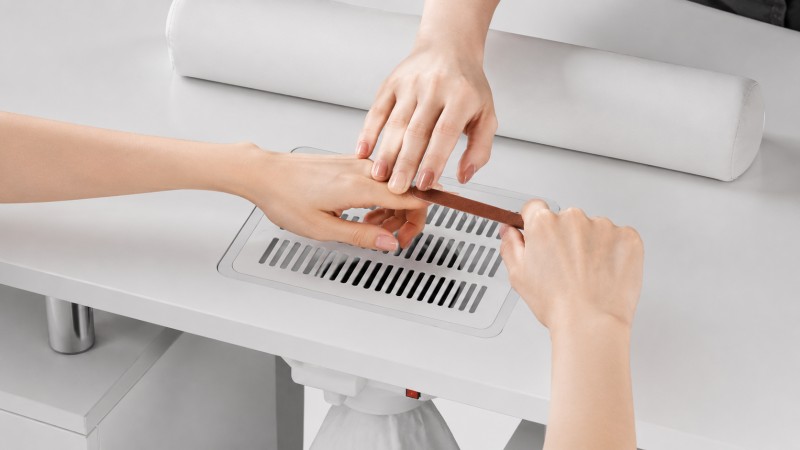
A built-in collector is most effective when the client’s hands are positioned close to the intake during filing.
It should also be remembered that many manicure table collectors are designed mainly for solid filing dust. They do not necessarily remove chemical vapors from acetone, adhesives, primers, polish, or other nail products.
The collector should therefore be used together with suitable room ventilation.
Maintenance methods depend on the collector design. Before removing or cleaning any component, confirm which system is installed in the manicure table.
This design uses a fan below the tabletop and a detachable fabric bag that catches filing dust.
It is easy to access, but the bag must be emptied before it becomes overloaded. Seams and attachment points should also be checked regularly.
Some systems use a flat panel or cartridge-style filter.
The filter may be:
Disposable
Reusable
Washable
Multi-layered
Combined with activated carbon
Never assume that a filter can be washed. Water may damage the filter media or reduce its ability to capture fine particles.
Some collectors direct larger nail fragments and dust into a tray before air reaches the main filter.
The tray should be emptied regularly to prevent debris from restricting airflow or entering the fan.
A ducted system carries air away from the table and may exhaust it outdoors.
These systems can provide stronger local extraction, but the ductwork, connections, and external fan require periodic inspection.
The exact schedule depends on the number of clients, the services performed, and the collector design.
| Frequency | Maintenance Task |
|---|---|
| After each client | Remove visible dust from the grille and table surface |
| End of each day | Check the intake and collection area |
| Weekly | Empty the bag or tray and inspect the filter |
| Monthly | Check airflow, fan noise, wiring, and mounting points |
| Every 3–6 months | Perform a deeper internal inspection |
| As needed | Replace clogged, damaged, or deformed filters |
| Annually | Arrange professional inspection for high-use or ducted systems |
A busy nail salon performing frequent acrylic removal or extension services may need to inspect the collector more often than a small studio offering mainly natural nail services.
It is better to follow a fixed schedule than to wait until the suction becomes noticeably weak.
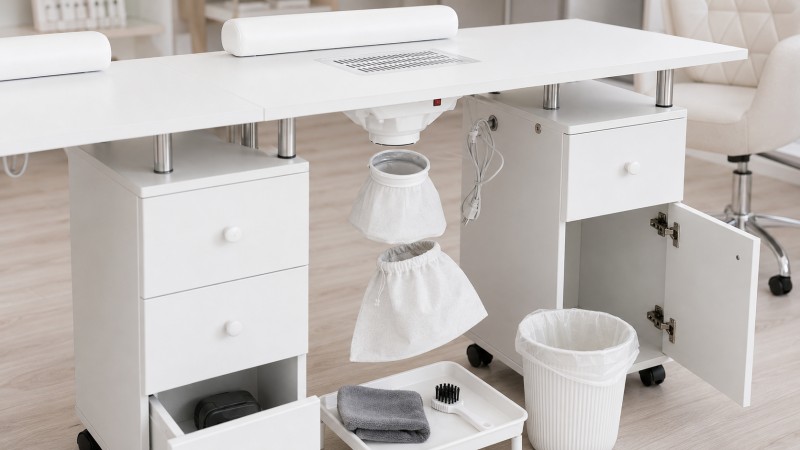
Always switch off and unplug the collector before removing the grille, filter, bag, or internal cover.
After each service:
Remove visible dust from the intake grille with a soft brush or suitable vacuum attachment.
Wipe the surrounding tabletop.
Check that the intake is not covered by a towel, wrist cushion, lamp, or product bottle.
Remove large nail fragments before they enter the system.
Apply cleaning products to a cloth rather than spraying directly toward the intake. Liquid entering the fan, filter, wiring, or tabletop structure may cause damage.
Once a week, or more often in a busy salon:
Disconnect the power.
Remove the filter, bag, or collection tray carefully.
Place collected dust directly into a sealed waste bag.
Vacuum accessible internal surfaces.
Inspect the grille, filter supports, fan guard, and collection chamber.
Reinstall the filter or bag securely.
Test the collector for normal airflow and sound.
Avoid shaking a dusty filter or bag inside the salon, as this releases captured particles back into the room.
Only wash a filter when the manufacturer specifically states that it is washable.
Before reinstalling it, make sure it is completely dry. A damp filter can restrict airflow, trap dust into a dense layer, create odors, or expose electrical parts to moisture.
Disposable paper, composite, HEPA-style, or activated-carbon filters should normally be replaced rather than washed.
Replace the filter or collection bag when:
Suction remains weak after cleaning
Dust passes through the material
The filter is torn or deformed
The bag seams begin to open
The filter no longer fits securely
Product residue cannot be removed
The material has become wet
A persistent odor remains
The recommended service limit has been reached
Salons should keep spare filters or collection bags in stock, especially when replacement parts are not readily available locally.
| Problem | Likely Cause | Recommended Action |
|---|---|---|
| Weak suction | Full filter or collection bag | Clean or replace it |
| Weak suction | Blocked intake grille | Remove dust from the openings |
| Uneven airflow | Filter installed incorrectly | Refit the filter and check the seal |
| Dust leaks below the table | Torn or loose collection bag | Secure or replace the bag |
| Dust remains around the hands | Working area too far from intake | Move the client’s hands closer |
| Collector becomes noisy | Loose mounting or debris near fan | Stop the unit and inspect it |
| Fan does not start | Switch, wiring, plug, or motor issue | Stop use and contact a technician |
| Motor becomes hot | Restricted airflow or mechanical problem | Turn off the collector immediately |
| Dust returns to the room | Incorrect filter or gaps around filter | Check filter size and installation |
Stop using the collector if it produces a burning smell, sparks, excessive heat, or repeated electrical interruptions.
Electrical repairs and internal motor work should be completed by a qualified technician.
A collector is easier to maintain when filters, internal parts, and replacement components are easily accessible.
Before purchasing a manicure table with a built-in dust collector, ask the supplier:
What type of filter or collection bag is used?
Is it washable, reusable, or disposable?
How often should it be replaced?
Are replacement filters available separately?
Can the intake grille be removed?
Is the fan replaceable?
What voltage and plug are required?
Is airflow adjustable?
Are spare switches, bags, or filters available?
Are maintenance instructions included?
For wholesale or salon project orders, spare filters and collection bags should be purchased with the manicure tables. They take up little shipping space and reduce future sourcing difficulties.
A simple maintenance record is also useful for salons with multiple stations. The record can include:
Table model
Filter type
Cleaning date
Replacement date
Suction problems
Repairs completed
This makes it easier to identify whether one unit needs more frequent service or whether filters are being replaced consistently.
The most important maintenance practices are simple:
Keep the intake clear.
Remove visible dust daily.
Empty collection areas weekly.
Replace damaged filters promptly.
Keep liquids away from the fan and wiring.
Monitor changes in airflow, sound, and temperature.
Use the collector together with room ventilation.
Regular care improves suction performance and reduces avoidable equipment failure.
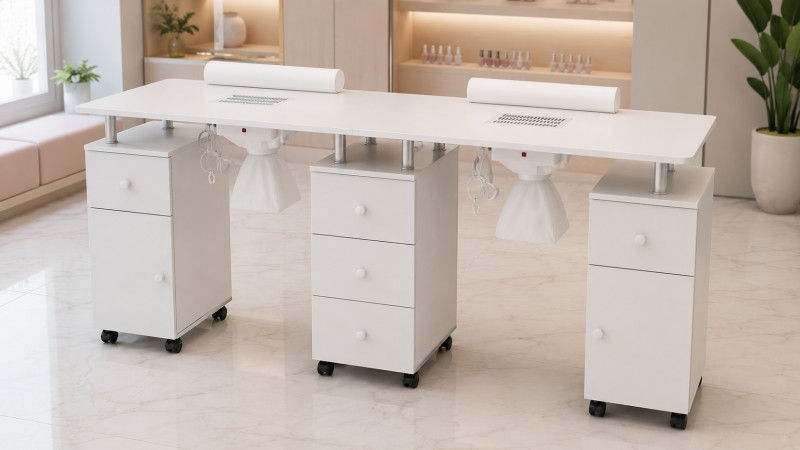
Dongpin manufactures professional manicure tables with integrated dust collectors, removable filter bags, storage drawers, display shelving, and customizable workstation layouts.
Table dimensions, colors, socket types, voltage, storage configuration, branding, and dust collection options can be confirmed for wholesale, distributor, franchise, and complete nail salon projects.
Remove visible dust daily and inspect the filter, bag, or collection tray weekly. High-volume salons may need to check the system more frequently.
The most common causes are a clogged filter, full collection bag, blocked intake grille, incorrectly installed filter, or internal obstruction.
Only when the manufacturer identifies it as washable. Disposable, paper, carbon, and multi-layer filters may be damaged by water.
No. Operating the unit without the correct filter can allow dust to enter the motor, furniture cabinet, or surrounding room.
Many built-in units are designed mainly for filing dust. They should not be treated as a replacement for suitable room ventilation or a dedicated vapor extraction system.
Do not spray liquid directly into the grille. Apply the cleaner to a cloth and wipe the surrounding surface carefully.
The collection bag may be full, torn, incorrectly installed, or detached. The filter may also be the wrong size or poorly sealed.
Keep compatible filters or collection bags and any model-specific parts recommended by the supplier.


"*" indicates required fields


