
In today’s competitive beauty industry, the operational success of a salon or spa relies not just on skill and service quality, but on how furniture and equipment are sourced and integrated into daily workflows.
Most salons still purchase through distributors or resellers. While convenient, this method often results in:
Higher costs due to cumulative markups
Inconsistent quality, with variations across batches
Unreliable delivery, affecting project timelines
Limited customization, forcing staff to adapt to generic furniture
From an OEM/ODM manufacturer’s perspective, direct factory-to-salon sourcing offers solutions that go far beyond cost savings. It ensures transparent pricing, quality assurance, customizable solutions, and reliable supply chains, enabling workflow optimization, improved ergonomics, and superior client experience.
Insight: Salons adopting factory-to-salon sourcing report 20–30% improved operational efficiency, simply by reducing setup and adjustment times across multiple services.
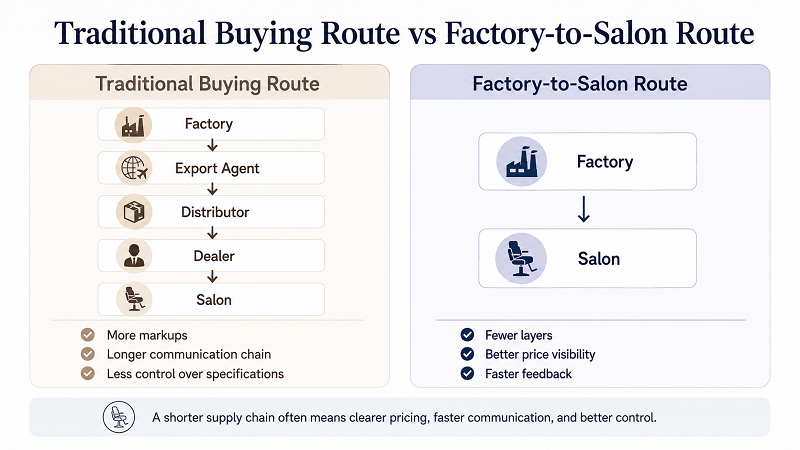
Indirect channels inflate costs due to multiple markups. The typical cost path is:
| Supply Chain Layer | Approximate Cost Increase |
|---|---|
| Factory (OEM/ODM) | Base production cost + factory margin |
| Export Agent | +10–15% |
| Distributor / Reseller | +10–20% |
| Local Dealer | +10–15% |
Direct sourcing eliminates intermediaries, allowing salons to purchase high-quality furniture at significantly lower costs.
Example: A multi-functional 6-motor spa bed might cost $520 via a distributor but $360–380 directly from the factory. For a studio ordering 10–15 beds, savings can reach thousands of dollars.
Actionable Tip: Request a line-item breakdown of materials, labor, and shipping to understand actual costs and identify potential savings.
Cost savings are most effective when strategically allocated:
Expand service capacity: Additional beds or chairs to handle more clients
Enhance client experience: Upgraded lighting, décor, and environmental ambiance
Improve staff efficiency: Ergonomic furniture reduces strain and turnover
Invest in technology: Scheduling, workflow, and inventory management tools
Case Study: A North American spa used savings from direct procurement to install intelligent scheduling software and ambient LED lighting. The result was a 15% increase in client throughput and improved customer satisfaction.
Direct sourcing gives salons visibility into material and structural integrity, critical for daily use:
Upholstery: PU leather grade, antimicrobial coating, tear resistance
Foam: High-density, resilient foam for comfort and longevity
Frame: Stainless steel gauge, weld quality, and load-bearing capacity
Mechanisms: Motors, hydraulics, and tilt systems for multi-functional beds
These factors directly affect client comfort, staff ergonomics, and furniture lifespan.
Before bulk orders, salons should:
Test comfort, ergonomics, and functionality
Evaluate assembly and cleaning convenience
Assess durability under real-world operational conditions
Case Example: A Scandinavian spa tested a head spa bed prototype with adjusted nozzle alignment, reducing setup time by 15% per session and improving operational efficiency.
OEM/ODM factories ensure standardized production across batches, maintaining consistent performance, durability, and aesthetics. This is especially important for multi-location salons to reduce maintenance and replacement costs.
Reference: Foreasy Home – Why Direct Sourcing Matters
OEM/ODM manufacturing allows furniture to support salon workflow rather than forcing staff to adapt:
| Service Type | Suggested Features | Operational Benefit |
|---|---|---|
| Head Spa / Massage | Adjustable tilt, LED lighting, water circulation | Reduces staff strain, enhances client comfort |
| Facial / Esthetic | Memory positions, motorized height adjustment | Consistent ergonomics, faster setup |
| Nail / Waxing | Multi-tier storage, integrated trays | Reduces movement, improves workflow efficiency |
Custom furniture ensures:
Fit for small or irregular treatment rooms
Multi-functional beds for premium suites
Coordinated sets (bed + trolley + stool) for optimized technician movement
Case Study: A Scandinavian spa integrated custom beds and stools for narrow rooms. Technician movement decreased by 25%, improving client experience and reducing staff fatigue.
Custom finishes, color schemes, and textures allow salons to reinforce brand identity, enhancing the perceived value of services.
Factory-to-salon sourcing typically offers 40–45 day production cycles for bulk orders. This includes:
Prototype/sample approval
Batch production
QC inspection before shipment
Predictable timelines allow salons to plan openings, expansions, or seasonal promotions efficiently.
Potential risks include specification miscommunication, shipping delays, and post-sale support limitations. Recommended strategies:
Document detailed specifications with annotated diagrams
Schedule multiple QC checkpoints
Negotiate warranty and parts replacement agreements
Supplier Evaluation: Production capacity, certifications, references, and communication responsiveness
Feature Prioritization: Core operational features first; aesthetic or optional features second
Sample Verification: Evaluate prototypes for ergonomics, durability, and cleaning
Batch Inspection: Include production checkpoints for consistency
Long-Term Partnership: Build relationships for recurring orders, priority production, and future product development
Global salon furniture market projected to grow from USD 5.5B in 2024 to USD 7.8B by 2030 (Grand View Research)
Direct sourcing reduces defects, improves operational consistency, and enhances client satisfaction (Foreasy Home)
Case studies indicate 30–40% fewer downtime incidents and measurable efficiency gains for staff
From an OEM/ODM perspective, direct factory sourcing is not just cost reduction — it is an operational strategy that ensures:
Transparent costs
High-quality, durable furniture
Customization aligned with workflow and branding
Reliable supply and responsive support
Salons seeking to scale efficiently, maintain professional standards, and enhance client experience will find factory-to-salon sourcing a practical, high-impact solution.


"*" indicates required fields


