

Head Spa Bed Drainage and Odor Troubleshooting
A Safe Guide for Salon Teams
A practical guide for salon owners, head-spa teams, facility managers and equipment buyers
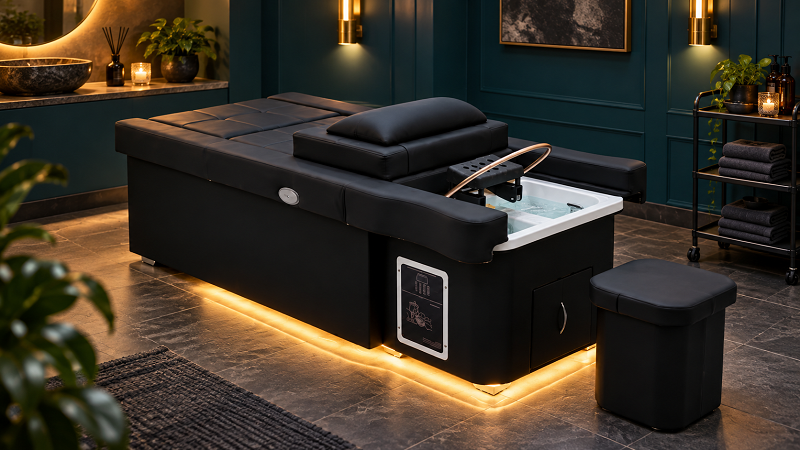
October 4, 2026
A head spa bed that leaves water standing in its shampoo basin, gurgles after a rinse or develops an unpleasant smell needs attention before the next appointment. The cause may be as simple as hair at an accessible basin opening, but it may also lie in the station's waste connection, a shared building drain or the way a self-contained unit handles water. Do not assume that a circulation setting, a strong chemical cleaner or another rinse will solve a wastewater problem.
The safest sequence is to stop the service if water is backing up, leaking or reaching electrical parts; identify which water path and which fixtures are affected; clean only parts the product manual identifies as user-serviceable; and hand plumbing or electrical work to the right professional. This guide explains that sequence without assuming every head spa bed has the same drain layout.
"Head spa bed" covers several configurations. A plumbed bed typically receives water from the building and discharges wastewater through an installed drain connection. A self-contained or "non-plumbing" model may store water on board, but it still needs a documented method for handling used water. Optional circulation, heaters and steam functions add other water paths. The external appearance alone does not reveal the internal routing.
For example, Dongpin's DP4271 electric head spa bed has a head-end acrylic shampoo basin and a separate foot-bath basin; water circulation and heating vary by configuration. Dongpin's DP-B10 non-plumbing head spa bed is listed with a 90-liter internal water tank and an ABS basin. Neither public product page is a complete drainage service manual. Before checking a tank, outlet or hose, confirm the exact model, ordered options and installation instructions for the unit in front of you.
Circulation is not drainage. A circulation feature reuses or moves water for a treatment effect. Wastewater still has to leave the basin through the unit's specified discharge route. If the basin drains slowly only when a treatment function runs, record that pattern for the manufacturer; do not open a pump housing to investigate it yourself.
Take the station out of service and keep clients away if any of the following occurs:
· Wastewater rises toward the rim, backs up from another fixture, or spills onto the floor.
· Water reaches a power cord, plug, control panel, motor enclosure or other electrical area; a breaker trips; or anyone feels a shock or tingling sensation.
· There is a persistent leak beneath the bed or around a connection you cannot safely inspect from outside.
· A strong sewer-like odor affects the room, especially if several drains are gurgling or the smell is not clearly traceable to removable surface debris.
· A self-contained unit has a full, leaking or unverified used-water container or discharge arrangement.
Stop the water flow. If electrical parts are wet, do not touch the wet equipment or plug; have a qualified person make it safe before inspection. OSHA advises against operating wet electrical equipment and calls for qualified inspection before re-energizing equipment that has gotten wet. Do not resume client services simply because the visible water has been mopped up.
The goal is to narrow down the fault, not to carry out a plumbing repair during salon hours. Use the product manual and your site's maintenance procedure as the authority for anything that can be removed or opened.
With the station out of service, write down whether the basin drains slowly throughout a rinse, only at the end, or not at all. Note any gurgling, smell, leak, error message or change after a recent installation or move. If the model has both head and foot basins, record which basin is affected. Photos of the empty bed, basin surface and visible connection area help the installer or supplier understand the problem without asking staff to dismantle the unit.
Is one head spa bed affected while the adjacent bed and hand-wash sink drain normally? That pattern points first toward that station's accessible inlet, its waste route or its individual connection. Are several fixtures slow, gurgling or smelling at the same time? A shared building drain or vent deserves priority. This is a diagnostic clue, not a final diagnosis: the City of York's blocked-drain guidance similarly recommends checking whether other sinks or toilets are affected.
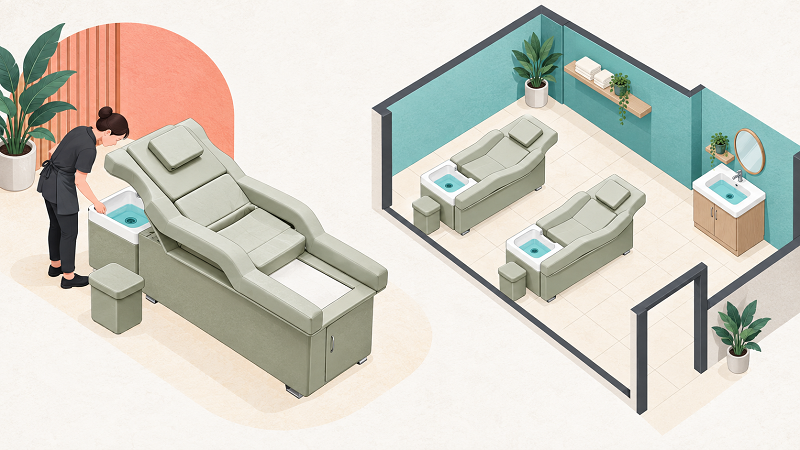
Compare nearby fixtures before deciding who should investigate
Put on appropriate gloves. Remove loose hair and product residue from the basin surface and any hair catcher, strainer or screen only if your model provides one and its instructions allow staff to remove it. Do not force a fixed fitting or push debris down the opening. Hair mixed with soap or treatment residue can build up and slow a drain; a Leicester City Council maintenance guide specifically recommends a strainer or regular removal of trapped hair to prevent blockages. Dispose of collected hair in a bin, then clean and reassemble user-removable parts according to the product instructions.
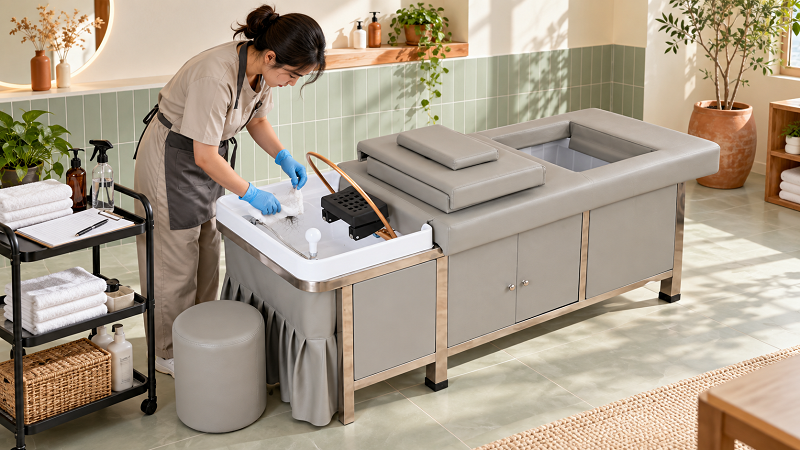
Inspect and clean only user-accessible basin surfaces and parts
If the installation leaves a hose or outlet visible without moving the bed or opening a service panel, look for an obvious kink, compression, disconnection or leak. Do not loosen joints, remove the trap, pull on a hose, open a cabinet containing electrical components or improvise a new drain route. On a tank-based unit, confirm the manufacturer's instructions for used-water collection and emptying; a product's stated tank capacity does not tell you the wastewater capacity or procedure.
Only if there is no leak, backup, odor hazard or electrical concern, and the manual permits it, use a modest amount of clean water to see whether flow has returned to normal. Have another person watch the accessible discharge area. Stop immediately if the level rises or water appears where it should not. If the problem persists after user-serviceable debris is removed, book the appropriate service professional rather than repeating the test with more water.
Symptom | Plausible area to investigate | Sensible next action |
Only one basin drains slowly | Hair or residue at an accessible opening; kinked or obstructed station waste route | Check user-serviceable parts and visible hose; then contact installer or supplier |
Several fixtures drain slowly or gurgle | Shared building drain or vent issue | Stop affected services and call a licensed local plumber or facility manager |
Basin empties, but odor remains | Residue at the basin; a nearby floor drain; trap or vent issue | Clean accessible surfaces, identify the odor source, and ask a plumber to assess persistent sewer-like smells |
Odor appears after a room has been unused | Stagnant water or, in a plumbed space, a dry trap at a nearby infrequently used drain | Follow the relevant maintenance instructions; have building plumbing checked if the odor persists |
Water appears under the bed | Leaking connection, container or internal component | Stop use; keep power isolated if wet; arrange qualified inspection |
Flow changes when circulation is switched on | Treatment-water or pump path may be involved, separate from simple gravity drainage | Record the mode and symptoms; ask the manufacturer or authorized technician |
These are possibilities, not a diagnosis of a particular Dongpin model. A technician needs the unit's installation diagram and an on-site inspection to identify the failed component.
Odor does not always originate inside the bed. Hair, oil and product residue left around an accessible basin opening can smell if cleaning is inconsistent. Water left standing in a self-contained system can also become unpleasant if its cleaning and emptying procedure is missed. In a plumbed room, a nearby floor drain may be the source instead. The US EPA explains that an evaporated water seal in a drain trap can allow sewer gases into a building. That does not establish that a particular head spa bed has a dry trap; it is one reason a building plumber should investigate an unexplained sewer-like odor.
Use your nose only to locate the general area, never as a safety test. If a strong odor is accompanied by a backup, symptoms among staff, or several affected drains, clear the room and follow local building and emergency procedures. Avoid masking the smell with fragrance, which delays finding the cause.
Avoid a "stronger is better" response. Caustic or acidic drain openers may be incompatible with a basin finish, hose, seals, pump or holding system; they can also leave a hazardous liquid for the next person who opens a connection. Do not use a drain snake, compressed air, boiling water or an enzyme product unless the manufacturer and local plumber specifically approve the method for that model and installation. Never combine products in an attempt to clear an odor or blockage. The CDC warns that mixing bleach or any disinfectant with other cleaners or disinfectants can release dangerous vapors.
If a chemical has already been used, tell the plumber or service technician exactly what was applied and when. Do not add another product to "neutralize" it.
Prevention is mostly about keeping hair out of the waste path and noticing changes before a booking is disrupted. Set the schedule from the manufacturer's instructions and your local hygiene requirements; the routine below is a workflow template, not a substitute for either.
After each client: remove visible hair from the basin and any approved user-accessible catcher; clean the basin using a product approved for its material; leave the station ready for the next service. If the bed has a separate foot-bath basin, include it in the same closeout check.
At the end of the day: inspect the basin opening, note any water that lingers longer than usual, check the floor for leaks, and follow the model-specific rinse, emptying and drying procedure for the unit's water system. Do not store damp removable components against the bed unless the manual allows it.
At a scheduled interval: review the maintenance log for recurring slow flow or odor; check accessible hoses and connections visually; confirm staff know where to find the manual and who to call. A repeat problem after cleaning is a service signal, not proof that staff are cleaning poorly.

Record recurring drainage symptoms and keep basin care consistent
Good documentation shortens the handoff. Provide the model and serial number; whether it is plumbed or self-contained; the ordered circulation, heater and steam options; date of installation; which basin is affected; whether other fixtures are affected; photos or a short video of the symptom; and a list of cleaning products already used. A plumber can assess building drainage, traps, vents and code compliance. The manufacturer or an authorized service technician can advise on model-specific parts, pumps, tanks and warranty-safe access.
For a new installation or multi-room order, confirm the location of water inlets, the approved wastewater discharge method, access for maintenance, electrical requirements and the local installer responsibilities before placing the beds. A "non-plumbing" product description does not override local rules: the Kentucky Board of Cosmetology, for example, sets plumbing requirements for shampoo bowls and a separate approval process for qualifying unplumbed portable stations. Check the requirements where your studio operates. If you are comparing layouts or need model-specific drainage information, contact Dongpin with your floor plan and intended head-spa configuration. Ask for the current installation drawing and maintenance manual for the exact configuration; do not design the room from a product photo.
The restriction may be farther along the station's waste route, or the building drain may be affected. Check whether other fixtures are slow, look for a visible kink or leak without dismantling anything, and then ask the installer or plumber to investigate. Repeatedly running water can turn a slow drain into an overflow.
Yes. Residue at the basin, standing water in a self-contained water system, or a nearby building drain can create odor even when the basin empties. Persistent sewer-like smell needs a plumbing assessment rather than fragrance or repeated disinfectant use.
No. Circulation is a treatment function; wastewater discharge is a separate requirement. The exact routing depends on the model and options. If flow changes only when circulation runs, record the setting and contact the supplier rather than opening the pump housing.
Not as a default remedy. Check the manufacturer's instructions and ask the responsible plumber first. Chemicals may be incompatible with components or create a hazard for anyone servicing the unit. Never mix cleaners or disinfectants.
It still needs a safe, documented way to handle used water, even if no fixed drain is required at the bed location. Ask the supplier for the exact fill, wastewater collection, emptying and cleaning procedure for your configuration; do not infer those details from the stated tank capacity.
Only when the cause has been corrected, the bed and surrounding floor are dry, wastewater flows as intended, there is no leak or unexplained odor, and any wetted electrical equipment has been cleared by a qualified person. Record the repair and the successful check before returning the station to service.


"*" indicates required fields


