
For years, people talked about technology in the nail industry as if it were mostly about convenience: faster booking, quicker payment, better lamps, more design options. That is all true, but it misses the bigger shift. Technology is not simply making nail services easier to deliver. It is changing what clients expect, what salon owners can measure, and what actually separates a scalable nail business from a fragile one. In that sense, technology is not just improving the nail industry. It is redefining its operating model.
The U.S. nail sector is still fundamentally a people business. According to the U.S. Bureau of Labor Statistics, manicurists and pedicurists held about 210,100 jobs in 2024, and employment is projected to grow 7% from 2024 to 2034, faster than the average for all occupations. BLS also projects about 24,800 openings per year over the decade. That matters because it shows something important: demand is still there, but growth alone does not guarantee that every salon benefits equally. When a category keeps growing, the real question becomes who captures that growth most efficiently.
My view is that technology is pushing the nail industry in three directions at once. First, it is reducing friction in the customer journey. Second, it is raising the baseline for professionalism and safety. Third, it is shifting advantage away from pure manual labor and toward systems, workflow, and repeatability. That third point is where the real change is happening. Nail salons used to compete mostly on location, price, speed, and artistic skill. Increasingly, they compete on how well they turn service into a consistent, data-backed, low-friction experience.
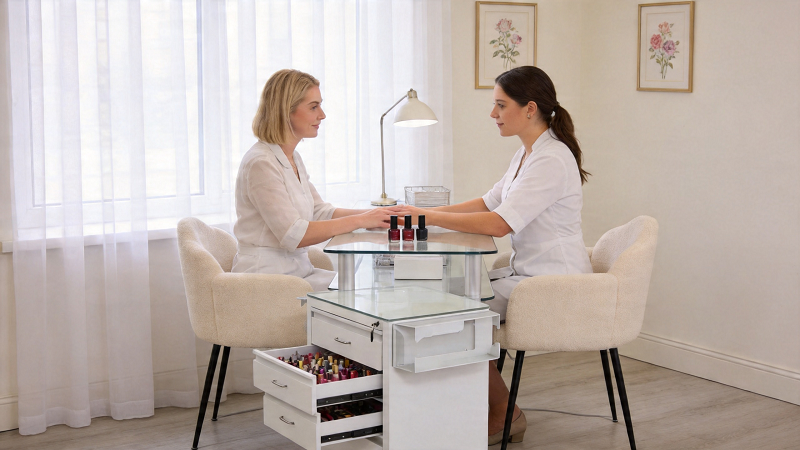
One of the clearest examples is booking and client communication. The Professional Beauty Association notes that automated email and text reminders can reduce cancellations and no-shows from 8% to under 1%. On paper, that sounds like an operational detail. In reality, it changes the economics of the business. A nail salon does not lose money only when a chair is empty. It also loses scheduling stability, staff utilization, and often the chance to fill that slot in time. A salon with strong automation is not just “more convenient.” It is structurally better at protecting revenue.
That is why I do not think online booking is the most important part of salon technology anymore. The more important shift is that digital tools make the business more legible. Once appointments, reminders, payment, retail, and rebooking sit inside the same operating system, the owner can finally see patterns that were previously hidden inside day-to-day busyness. The PBA’s KIM reporting framework, for example, tracks monthly averages such as revenue per salon, service ticket, product revenue, unique clients, unique visits, and staff counts, drawing from data partnerships representing more than 50,000 salons and 22 million clients across the U.S. That kind of visibility changes decision-making. A salon no longer has to guess which services are driving profit, which time blocks underperform, or whether retail is actually contributing.
This is where technology creates a deeper divide in the industry. Some salons use software as a digital appointment book. Others use it as a management layer that informs pricing, staffing, retention, upselling, and service design. The first group becomes more organized. The second group becomes more scalable.
When people think of beauty tech, they usually picture flashy tools: nail printers, AI manicure machines, color-changing press-ons, social filters, digital design apps. Those innovations matter, but they can distract from the technologies that create the most durable value.
The CDC’s current guidance for nail technicians emphasizes that salons should use good ventilation and, beyond general room ventilation, local exhaust ventilation at workstations. It specifically points to solutions such as portable units that filter or exhaust air outdoors and downdraft ventilated tables. That is not glamorous technology, but it may be more important than many front-end innovations because it affects the daily health environment of the business.
This is where I think the industry is heading: the winning salons will not necessarily be the ones with the most visible tech. They will be the ones that use technology to build trust. In nail services, trust is built through cleanliness, consistency, and physical comfort as much as design. Better source capture, smarter table design, stronger ventilation, and cleaner workflow do more than reduce exposure concerns. They signal professionalism. They tell both the client and the technician that the business is built to last, not just to look trendy on social media.
In that sense, safety technology is becoming a brand asset. That is a major shift. For years, many beauty businesses treated ventilation and workstation ergonomics as background issues. But as regulations, worker expectations, and public awareness continue to rise, those “background issues” increasingly shape how a salon is perceived. A beautiful salon without proper operational infrastructure may still attract attention. A well-designed salon with a healthier work environment is more likely to keep staff, reduce friction in daily operations, and build long-term credibility. The CDC guidance and EPA workplace materials both point in the same direction: source control and ventilation are not side topics; they are part of modern salon practice.
On the creative side, technology is also changing what can be standardized. O’2NAILS markets desktop and portable nail printers with app-based design functions, automatic nail-shape recognition, and 2400 DPI printing resolution. CES has also highlighted consumer-facing manicure devices such as Nimble, which uses nail scanning, robotic movement, and app-connected operation, while CES 2026 exhibitors included iPolish, which presented app-controlled color-changing press-on nails. These examples do not mean salons are about to be replaced by machines. What they show is that the category is moving toward programmable beauty.
That has a deeper consequence for salons. Once certain forms of intricate visual output become easier to digitize or automate, simple decoration becomes easier to commoditize. In other words, technology can lower the value of services that rely only on novelty or pattern complexity. When a machine can help execute detailed visuals faster, the salon’s value has to move somewhere else: consultation, prep quality, retention, finishing, hand skill, customization, hygiene, comfort, atmosphere, and brand identity.
This is why I do not believe technology will make professional nail services less relevant. I think it will force salons to become more intentional about what part of the service they truly own. A machine may help with pattern placement. It does not replace client trust, nail health judgment, prep discipline, or the physical experience of being cared for by a skilled technician. Technology raises the floor. It does not automatically replace the ceiling.
Another shift that is easy to underestimate is regulation and ingredient awareness. The FDA states that nail products sold in the United States are generally regulated as cosmetics unless they are intended to treat medical problems, and that these products must be safe when used according to labeled directions or customary use. The agency also stresses the importance of following label directions and paying attention to warning statements, while specifically addressing ingredient categories such as formaldehyde, methacrylate monomers, methacrylic acid, phthalates, and toluene in nail-related products.
That matters because technology is accelerating not only service delivery, but also product complexity. New systems, stronger formulations, DIY kits, at-home devices, and social-media-driven techniques all move faster than many consumers fully understand. As a result, salons that can communicate clearly about product use, safety, wear expectations, and ingredient handling gain an edge. In the next phase of the industry, education is part of the premium.
This is especially relevant because research literature continues to point to exposure and allergy concerns around nail work, including issues related to ventilation and acrylate-based products. A recent systematic scoping review indexed by PubMed found that inadequate ventilation was a common finding across nail salon workforce studies, while other peer-reviewed literature has documented rising concern around methacrylate-related allergic contact dermatitis. These are not reasons to alarm clients. They are reasons for serious businesses to operate with more discipline.
The deeper pattern, in my view, is that technology is splitting the nail market into two different lanes.
One lane is high-throughput convenience: faster service, digital booking, faster check-in and checkout, lighter customization, stronger repeatability, and more standardized outputs. This lane benefits from automation, tighter workflows, and better utilization of labor hours. The other lane is high-trust specialization: stronger consultation, better environment, healthier workflow, more premium materials, better retention, and more design identity. This lane benefits from technology too, but mostly behind the scenes. It uses tech to support a premium service rather than to make the tech itself the hero.
That is why the future of nail technology is not really about whether a robot can paint nails or an app can generate designs. The deeper question is this: what part of the service experience becomes more valuable when technology handles the repeatable parts? My answer is that human judgment, trust, atmosphere, and execution quality become more valuable, not less.
The biggest mistake beauty businesses can make is treating technology as decoration. In the nail industry, technology matters most when it improves the fundamentals: fewer no-shows, clearer data, healthier workstations, better compliance, more consistent delivery, and a smoother client journey. The salons that win will not be the ones chasing every new gadget. They will be the ones using technology to build a stronger operating system around a very human service.
Q1. Will technology replace nail technicians?
A: No. Technology can automate certain repetitive parts of the service process, but it does not replace skilled prep work, nail shaping, product knowledge, sanitation standards, or client care. In most cases, technology works best as a support tool that helps nail professionals deliver a more consistent and efficient service.
Q2. Why is ventilation technology important in nail salons?
A: Ventilation technology helps reduce exposure to dust and chemical vapors created during nail services. Proper source capture and workstation ventilation support a healthier environment for both technicians and clients, and they are becoming an increasingly important part of professional salon design.
Q3. What kinds of technology matter most for nail salon owners?
A: For most salon owners, the most valuable technologies are booking software, automated reminders, integrated payment systems, reporting tools, and workstation solutions that improve safety and workflow. These tools may not be the most visible, but they often have the biggest impact on daily operations and long-term profitability.


"*" indicates required fields


