
Head spa studios are no longer a niche concept in Europe. From Italy and France to Germany and Spain, more salons and wellness spaces are adding scalp treatment and head spa services as a dedicated offering—not just an add-on to hair washing.
But opening a head spa studio is not the same as opening a traditional salon. The experience is longer, more immersive, and far more dependent on the right equipment choices.
This guide is written for European salon owners, spa operators, and wellness entrepreneurs who want something practical:
what to prepare, what to buy, and what to avoid—without over-investing or making early mistakes.
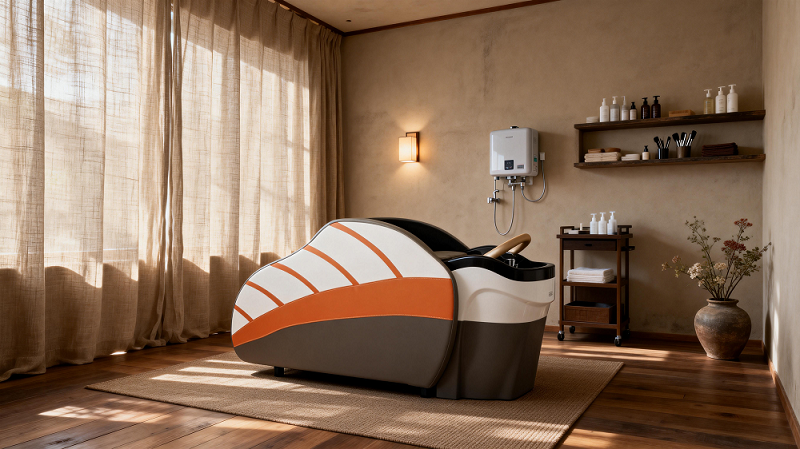
In Europe, head spa succeeds not because it improves hair washing, but because it aligns with how people understand relaxation and wellness.
For most European clients, relaxation is defined by the absence of physical effort.
A successful treatment allows the body to remain passive: no active posture holding, no repeated adjustments, no need to cooperate with the equipment.
This is why massage, physiotherapy, and wellness treatments in Europe share a common structure:
The client lies down
The body is supported, not positioned
The environment adapts to the client, not the other way around
Head spa is judged by the same logic.
In European perception:
Hair washing is hygiene
Hygiene is functional
Functional services are not where people seek relaxation
If head spa is framed—directly or indirectly—as an enhanced hair wash, its perceived value immediately drops. What clients respond to instead is the removal of physical strain, especially in the neck, shoulders, and lower back.
This is not a question of quality, but of design assumptions.
Common mismatches include:
Equipment designed for short sessions used in long treatments
Firm support that is acceptable in Asia but uncomfortable for European bodies
Environments that are visually impressive but physically demanding
European clients are generally less tolerant of discomfort, especially around the cervical spine. If the body feels “managed” rather than supported, trust erodes quickly—even if the service technique itself is good.
Most head spa studios do not fail because of poor service skills.
They fail because of early structural decisions that shape daily operation.
Beauty furniture is typically designed for:
Short interaction
Frequent client movement
Visual impact
Head spa equipment must support:
Long static sessions
Minimal repositioning
Physical neutrality over time
Using beauty-oriented logic to select head spa equipment often results in setups that look acceptable but feel increasingly uncomfortable as session length increases.
Many chairs and beds feel acceptable for the first 5–10 minutes.
The problem appears after 30–40 minutes, when neck angle, shoulder tension, or lumbar strain becomes noticeable.
Clients rarely complain directly. Instead, they describe the experience as “nice, but tiring,” or simply do not return.
Head spa sessions are repetitive and physically demanding for staff.
Common issues include:
Beds positioned too low, forcing constant bending
Restricted access on one side, creating uneven strain
Poor tool placement, interrupting workflow
If therapists finish the day exhausted, service quality inevitably declines.
Water is not just a utility in head spa.
It is part of the sensory environment.
Noise, splashing, and inconsistent flow directly affect relaxation, even if clients cannot articulate the problem clearly.
Many systems perform well during the first year. Problems appear later:
Slower drainage
Increased noise
More frequent cleaning interruptions
These are rarely material failures. They are design and access failures.
This section is not about brands or models.
It is about how water behaves, and why that behavior matters.
Every head spa system follows the same basic sequence:
Water supply enters the system
Water interacts with the client and basin
Water exits through drainage
Most operational problems occur between steps 2 and 3.
Many head spa studios in Europe operate in:
Older buildings
Converted residential spaces
Protected or semi-protected structures
These environments often have:
Limited pipe slope
Smaller pipe diameters
Strict property management rules regarding leakage
In such conditions, aggressive drainage solutions amplify risk rather than reduce it.
Based on long-term use patterns, the following designs are consistently problematic:
Shallow drainage points
Sudden pipe diameter changes
Water falling directly into hard vertical piping
Systems relying on suction rather than gravity
Noise is not random. It is structural.
Some systems perform well initially but degrade over time due to:
Complex drainage paths that are difficult to clean
Residue buildup reducing flow
Air turbulence introduced as flow slows
A critical design question is:
Can the entire water path be cleaned and inspected easily after one year of daily use?
Floor drainage follows gravity naturally, is quieter, and is easier to maintain, but requires early planning.
Wall drainage may be necessary in retrofit projects, but demands precise installation and careful flow control to avoid noise and splash.
Neither option is inherently “better.” The risk lies in choosing without understanding the consequences.
Therapists care about predictability and cleanliness
Clients care about silence and comfort
Property owners care about leakage risk and maintenance access
A successful system addresses all three.
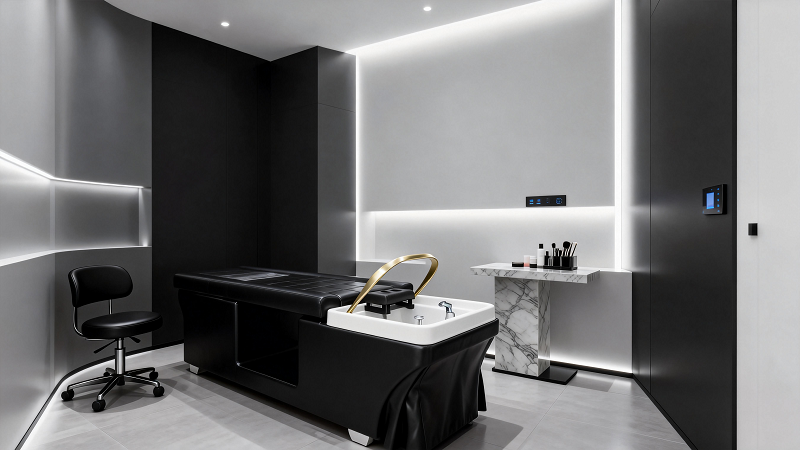
Most head spa rooms fail at the same point: they look correct on paper but become inconvenient once daily operation starts.
The first issue usually appears around bed placement. When a head spa bed is positioned too close to walls or decorative elements, therapists lose access to one side, cleaning becomes slower, and maintenance requires moving the bed entirely. Over time, this leads to shortcuts in hygiene and more frequent minor damage to finishes and equipment. A workable layout always allows clear access on both sides of the bed and enough space at the head area for adjustment and cleaning.
The second issue is how clients enter and leave the bed. In many studios, the client must twist, step around furniture, or stand up onto a wet floor. This is not a design problem—it is a workflow problem. The space around the bed must allow a straight, stable movement from lying to standing, with dry flooring and clear hand support if needed. This is especially important for older clients or those booking head spa for stress or physical discomfort.
The third issue is therapist movement during repeated sessions. If tools, towels, and controls are not within easy reach, therapists walk unnecessary steps dozens of times per day. What seems minor in one session becomes physical fatigue over weeks. Efficient head spa rooms are designed so that the therapist can complete the entire treatment, cleaning included, with minimal repositioning and no repeated bending or detours.
Most early overspending in head spa studios happens in the wrong areas. Complex devices, decorative lighting systems, and “signature features” are often purchased before the core setup has been tested in real operation. These elements rarely improve client retention in the first six months and often increase maintenance and training burden.
What cannot be delayed are decisions that affect comfort and reliability. If the bed does not support the body properly for long sessions, or if the water system produces noise or splashing, no later upgrade will fully correct the problem. These are structural issues that must be solved before opening, not after.
Many successful studios follow a simple approach: start with a stable, comfortable base and observe how the space is actually used. Only after several months of operation do they invest in advanced devices or atmosphere upgrades, guided by real client behavior rather than assumptions.
Opening a head spa studio in Europe is less about creating something new and more about removing sources of discomfort that clients already avoid in daily life.
Projects that struggle usually do so not because of poor service quality, but because of early decisions that ignored session length, body support, water behavior, and daily workflow. These factors rarely appear in marketing materials, yet they define whether a studio operates smoothly or constantly compensates for design flaws.
A well-functioning head spa studio feels calm not because it adds more elements, but because nothing interferes with the treatment. When posture is natural, water is quiet, and movement is straightforward, the service becomes repeatable, scalable, and sustainable.


"*" indicates required fields


