
What Certifications Do You Need to Import and Resell a Podiatry Chair?
Medical-device and beauty-use requirements for North America, South America, Europe, Southeast Asia, Australia and New Zealand
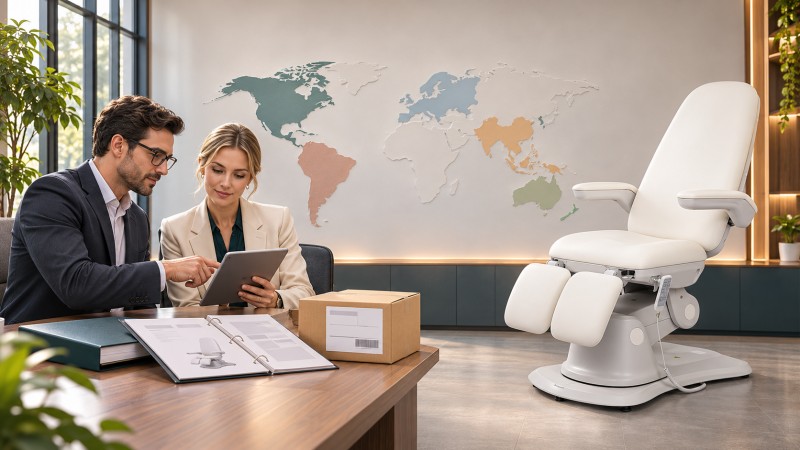
Plan podiatry chair certification before importing for resale
Importers often ask whether a podiatry chair needs CE certification, FDA approval or another international certificate. There is no single certificate that authorizes the same chair in every country. The correct route depends first on what the manufacturer says the chair is intended to do, and then on the rules of the destination market.
A powered split-leg chair marketed for clinical examination, diagnosis, treatment, rehabilitation or professional podiatry may fall within medical-device law. The same basic hardware marketed only for pedicure positioning, nail care or non-medical beauty services may instead be regulated as electrical furniture or general consumer/professional equipment. Product labels, instructions, website claims, distributor advertising and registration documents must all support the chosen route.
This guide gives B2B distributors a practical planning framework for major markets. It is not a classification decision or legal opinion. Before ordering a commercial shipment, confirm the current product classification and importer obligations with the national authority or a qualified local regulatory adviser.
For a medical-use podiatry chair, plan for four layers of evidence:
1. A documented intended purpose and country-specific risk classification.
2. Medical-device market authorization, registration, notification or listing where required.
3. A locally established authorized representative, sponsor, registration holder or licensed importer where required.
4. Technical documentation covering safety, electrical performance, EMC, risk management, labeling, quality controls and post-market responsibilities.
For a beauty-only foot-care chair, medical-device registration may not apply if the product has no medical intended purpose or claims. However, the chair can still be subject to electrical safety, electromagnetic compatibility, hazardous-substance, radio, consumer-product, labeling, importer and workplace rules. “Not a medical device” does not mean “no compliance work.”
The first commercial decision should therefore be: Are you buying a medical chair, a beauty chair, or two separately documented versions?
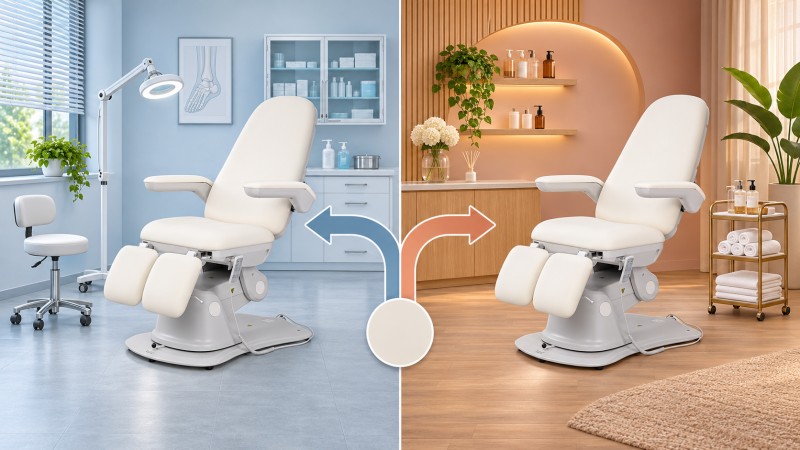
Medical intended use and beauty-only use follow different compliance routes
Question | Medical-use version | Beauty-only version |
Intended purpose | Patient examination, podiatry treatment, clinical positioning or another stated medical purpose | Pedicure, nail care, cosmetic foot care, salon positioning or relaxation |
Typical users | Podiatrists, clinicians, hospitals, medical practices | Nail technicians, beauty therapists, spas, salons |
Claims | Medical or therapeutic claims supported by evidence | Non-medical comfort, positioning and workflow claims |
Main regulatory route | National medical-device framework plus applicable electrical and environmental rules | General electrical, EMC, consumer/professional product and local market rules |
Technical file emphasis | Medical risk management, essential safety and performance, clinical or performance evidence, post-market surveillance | Product safety, electrical/EMC evidence, materials, labeling, instructions, traceability and consumer safety |
Local partner | Often an authorized representative, sponsor, registration holder or licensed medical-device importer | Commercial importer, responsible economic operator or local supplier as required by general product law |
The distinction must be real. Removing the word “medical” from one carton while distributors continue to advertise disease treatment or clinical examination will not create a defensible beauty-only product. Authorities normally look at the full intended-use evidence, including online listings and promotional material.
If one chassis is sold into both channels, create separate SKU control, declarations, labels, instructions and approved marketing copy. Prevent dealers from mixing the two versions.
Buyers use the word certification for several different things. They should be separated in the purchase specification.
· Product registration or market authorization: Permission, notification or listing under a national medical-device system.
· Conformity assessment: Evidence that the product meets applicable legal requirements; this may involve a notified or approved third party depending on the market and classification.
· Quality-management certification: For example, ISO 13485 certification of a medical-device quality system. This supports the manufacturer’s system but is not itself market authorization for a product.
· Test reports: Electrical safety, EMC, ingress protection, materials or other laboratory reports. A component report does not automatically cover the complete chair.
· Economic-operator licence: A licence held by the importer, distributor, sponsor, authorized representative or registration holder.
· Customs documentation: Tariff classification, origin documents, commercial invoice and import permits. Customs clearance does not replace product compliance.
A supplier statement such as “CE motor” or “FDA factory” is not enough. The legal product is the complete chair with its power supply, controls, accessories, labels, instructions and declared intended use.

Build a separate podiatry chair compliance plan for each destination market
The table below summarizes the usual planning route. It does not assign a risk class to a specific model. Classification must be confirmed from the final intended purpose and technical design.
Market | If sold for medical use | Local market participant | If sold only for beauty use |
United States | Confirm FDA device status and classification; complete any required premarket route, establishment registration, device listing, labeling and quality-system duties | Foreign manufacturer appoints a U.S. agent; initial importer has FDA obligations | No FDA device route if genuinely non-medical; confirm electrical, workplace, radio and general product-safety requirements |
Canada | Class I generally uses the MDEL route; Class II-IV require an MDL and the importer generally needs an MDEL | Canadian importer or distributor with the correct MDEL activities | Confirm provincial electrical approval and general product-safety obligations; avoid unsupported medical claims |
Mexico | Determine classification and whether COFEPRIS sanitary registration and import authorization apply | Mexican registration holder/importer with establishment permissions | Confirm applicable NOM, electrical, labeling and consumer rules with the importer |
European Union/EEA | EU MDR conformity route, CE marking, technical documentation, EU declaration, authorized representative for non-EU manufacturer, importer duties and UDI/EUDAMED duties where applicable | EU authorized representative and EU importer | Apply relevant general product rules and, for an electric model, evaluate LVD, EMC, RoHS, WEEE and other applicable legislation; CE is affixed only where legislation requires it |
Great Britain | UK medical-device rules, MHRA registration and valid conformity marking under current transitional arrangements | UK Responsible Person for a manufacturer outside the UK; importer information supplied to MHRA | Confirm current UK product-safety, electrical and EMC marking rules; Northern Ireland follows a different route |
Brazil | ANVISA classification and either notification or marketing authorization; certain electromedical equipment also needs INMETRO/SBAC conformity assessment | Brazilian authorization holder legally established in Brazil | Confirm whether the non-medical chair falls under compulsory INMETRO or other consumer/electrical requirements; avoid medical or regulated aesthetic claims |
Argentina | ANMAT medical-device registration and an authorized local importer/manufacturer establishment | ANMAT-authorized Argentine establishment | General electrical, commercial and consumer rules apply; confirm product-specific requirements locally |
Singapore | HSA dealer licensing plus product registration unless exempt, based on risk class | Licensed Singapore importer/wholesaler and local registrant arrangements | Medical registration is not used for a true beauty product; confirm consumer, electrical and workplace requirements |
Malaysia | MDA device registration plus separate establishment licences for relevant roles | Licensed authorized representative, importer and distributor as applicable | Confirm electrical/consumer requirements; do not use medical claims without the medical-device route |
Thailand | Thai FDA establishment licensing, risk classification and listed/notified/licensed product certificate as applicable | Thai establishment registrant/importer | Confirm Thai industrial, electrical, labeling and consumer rules for the exact product |
Indonesia | Ministry of Health distribution permit for imported medical devices and licensed local distribution route | Authorized Indonesian distributor/importer holding the relevant permissions | Confirm national electrical and consumer-product requirements and ensure marketing remains non-medical |
Philippines | FDA License to Operate for the establishment and applicable product market authorization | Licensed medical-device distributor/importer | Confirm general product, electrical and consumer requirements; avoid medical-device representations |
Australia | Australian sponsor and ARTG inclusion unless an exemption applies; conformity evidence must be available | Australian-based sponsor | If not a therapeutic good, confirm electrical safety, EMC/RCM and consumer-law requirements |
New Zealand | New Zealand sponsor and WAND notification for a medical device, plus sponsor records and post-market duties | New Zealand sponsor/importer | Confirm electrical, EMC and general product-safety requirements; WAND is not used for a genuinely non-medical chair |
For a medically intended chair, the starting point is not “FDA approval” as a generic phrase. Determine whether the product meets the U.S. medical-device definition, identify the regulation and product code, confirm its class, and determine whether it is exempt from premarket notification or needs a cleared or approved submission. The FDA states that foreign manufacturers importing medical devices must meet applicable requirements such as establishment registration, device listing, quality-system, labeling, reporting and any required premarket submission. A foreign manufacturer must designate a U.S. agent, and the initial importer has its own regulatory role. See the FDA’s medical-device import requirements.
For a beauty-only chair, FDA medical-device registration should not be presented as a selling point if the product is not a medical device. The importer should instead confirm the applicable electrical product standard, workplace or local inspection requirements and any state-specific rules. A UL or ETL mark is commonly requested commercially, but the required route depends on use, installation and the authority having jurisdiction. Wireless functions can add FCC obligations; a simple wired chair should not be advertised as “FCC certified” without a defined basis.
Health Canada uses two different licences. Class II, III and IV devices require a Medical Device Licence, while companies importing or distributing medical devices generally require a Medical Device Establishment Licence. For Class I, there is no MDL, but the MDEL route normally applies to the importing or selling establishment unless an exemption applies. Health Canada explains these roles in its medical-device licensing overview.
For a beauty-only electric chair, confirm acceptable electrical certification for the province and intended commercial premises. Do not assume that an EU CE declaration satisfies Canadian electrical approval.
For medical use, determine whether COFEPRIS sanitary registration is required and ensure that the local holder and importer are authorized for the activity. COFEPRIS publishes registration guidance and lists of registered products on its medical-device registration portal.
For beauty use, the Mexican importer should identify the applicable NOM standards, electrical safety, labeling and consumer requirements for the exact configuration. A medical registration should not be pursued merely to strengthen marketing if the product has no medical intended purpose.
When the chair is a medical device, the EU Medical Devices Regulation applies. The manufacturer must document classification, meet the general safety and performance requirements, complete the correct conformity assessment, issue the EU declaration of conformity and affix CE marking. A manufacturer outside the EU must appoint an EU authorized representative. Importers must verify items such as CE marking, required information and UDI where applicable, and must manage complaints, non-conformities and storage or transport responsibilities. The European Commission summarizes these roles for medical-device economic operators.
Do not use a certificate issued only for the motor as proof that the whole chair meets the MDR. Also do not assume every Class I product uses the same self-declaration route: sterile, measuring or reusable surgical-device features can change conformity-assessment involvement, and classification must be documented.
For a beauty-only electric chair, the MDR route may not apply, but several EU laws may still be relevant. Depending on voltage and design, evaluate the Low Voltage Directive, EMC Directive, RoHS, WEEE, the General Product Safety Regulation and national language or producer-responsibility rules. The European Commission stresses that CE marking follows the applicable legal conformity process; it is not a general quality badge or a certificate purchased from any laboratory.
Great Britain and Northern Ireland must be treated separately. For Great Britain, medical devices must be registered with the MHRA. A manufacturer outside the UK appoints a UK Responsible Person, and current rules include transitional acceptance of certain CE-marked devices. Because timelines and recognition arrangements can change, use the current MHRA guidance for placing medical devices on the UK market when planning each shipment.
A beauty-only version follows the applicable UK product-safety, electrical and EMC regime rather than medical-device registration. Confirm the current marking route for the shipping date instead of copying an old CE-versus-UKCA checklist.
Brazil is especially important because ANVISA states that medical equipment includes items such as hospital beds and examination chairs, and its scope can include equipment intended for aesthetic purposes. Under RDC 751/2022, Class I and II devices use notification, while Class III and IV devices use marketing authorization. Certain electromedical equipment must also undergo conformity assessment within the Brazilian system before ANVISA filing. A foreign company cannot hold the authorization directly; it needs a legally established Brazilian partner. See ANVISA’s current medical-device regulatory overview.
For a beauty-only chair, do not assume that the word “beauty” automatically removes ANVISA interest. The Brazilian partner should review the stated aesthetic purpose, product claims and whether compulsory INMETRO requirements apply. Keep medical and non-medical catalogues separate.
For medical use, work through an establishment authorized by ANMAT and confirm the product-registration route, classification and required technical file. ANMAT maintains its medical-device regulatory index, including establishment authorization, device registration and foreign-trade rules.
For non-medical beauty use, the importer should confirm electrical safety, consumer protection, labeling and customs requirements. Do not reuse an ANMAT-oriented medical IFU for a beauty-only SKU without reviewing every claim.
ASEAN countries use a harmonized framework, but they do not issue one ASEAN-wide registration. The ASEAN Medical Device Directive provides common principles, risk classification and a Common Submission Dossier Template, while each member state operates its own authority, licence and product-entry process. The official ASEAN medical-device framework is therefore a dossier foundation, not a regional market authorization.
HSA requires a dealer’s licence for medical-device importing or wholesaling. Medical devices generally require product registration before supply, except Class A devices and other specified exemptions. Confirm the route in HSA’s medical-device regulatory overview.
Medical devices must be registered, and establishments performing manufacturer, authorized-representative, importer or distributor roles require the corresponding MDA licence. An importer may import registered devices only when authorized through the medical-device supply chain. See MDA’s establishment licence guidance.
The Thai FDA requires establishment registration for commercial manufacture or import and applies a four-class risk system aligned with the ASEAN framework. Depending on class, the product route leads to a listed, notified or licensed certificate. The authority outlines the steps in its medical-device importer guidance.
Imported medical devices require a distribution permit and an appropriately authorized local distribution route. The Ministry of Health explains that imported-device permit numbers use the AKL prefix and provides verification resources through its medical-device licensing FAQ.
The Philippine FDA requires establishments dealing in regulated health products to hold the appropriate License to Operate and, when applicable, a product market authorization such as a Certificate of Product Registration or notification. Confirm the active route for the device and class with the Philippine FDA licensing framework.
For beauty-only chairs in Southeast Asia, remove medical claims only if the actual intended purpose is non-medical, then assess each country’s electrical safety, EMC, labeling, local-language, consumer and importer rules. ASEAN harmonization does not turn a report accepted in one country into automatic permission in another.
If the product is a medical device, an Australian-based sponsor must apply for inclusion in the Australian Register of Therapeutic Goods unless an exemption applies. The sponsor needs access to manufacturer documentation and remains responsible for regulatory information, safety alerts and recalls. The TGA describes this process in its medical-device inclusion guidance.
If the chair is genuinely non-therapeutic, ARTG inclusion may not apply. The importer still needs to assess electrical safety, EMC and RCM obligations, consumer guarantees, labeling and state or territory electrical rules.
For a medical device, the New Zealand sponsor must notify the device to the WAND database and maintain supply and recall records. Each sponsor-device combination has its own notification. Medsafe emphasizes that WAND notification is not product approval.
A beauty-only chair does not use WAND simply because it resembles clinical furniture. The importer should instead confirm electrical, EMC and product-safety duties for the exact power and control configuration.
The required dossier varies by market and classification, but a distributor should normally ask for:
· Intended-purpose statement and approved indications.
· Product description, model matrix and accessory list.
· Classification rationale for each target market.
· Design drawings, bill of materials and critical-component records.
· Risk-management file aligned with ISO 14971 where applicable.
· Quality-system evidence, commonly including ISO 13485 when required or commercially expected.
· Electrical safety and EMC evidence appropriate to the complete product.
· IEC 60601-series evidence if the final classification and design make the chair medical electrical equipment; do not assume the standard applies or does not apply without a documented assessment.
· Mechanical stability, load, entrapment, movement, emergency and durability evidence.
· Biocompatibility assessment for patient-contact materials where applicable.
· Cleaning, disinfection and material-resistance evidence.
· Label, symbols, serial-number system, instructions for use and local-language plan.
· Clinical or performance evaluation appropriate to the intended purpose.
· Post-market surveillance, complaint, vigilance, field-action and recall procedures.
· Declarations, certificates and registrations that identify the complete model family.
The KFM-T108 electric podiatry chair and DP-Z32G podiatry chair illustrate why the technical file must be model-specific: height range, tilt, split-leg movement, patient weight and rated load are not interchangeable across products.
A non-medical file should still be substantial:
· Written non-medical intended purpose and prohibited-claims list.
· Complete product specification and model/option matrix.
· Electrical safety and EMC reports for the complete configuration.
· Power supply, plug, voltage and frequency variants by market.
· Stability, load, pinch-point, moving-section and durability testing.
· Upholstery chemical and restricted-substance evidence where applicable.
· Cleaning and maintenance instructions suitable for salon use.
· Product label, serial traceability, warnings and local-language instructions.
· Packaging and transport tests.
· Importer contact, complaint, corrective-action and recall process.
· Evidence for any voluntary claims such as ingress protection, flame resistance or antimicrobial material.
Do not include medical symbols, clinical indications or disease claims in the beauty version merely because they appear more professional. They can change the classification analysis.
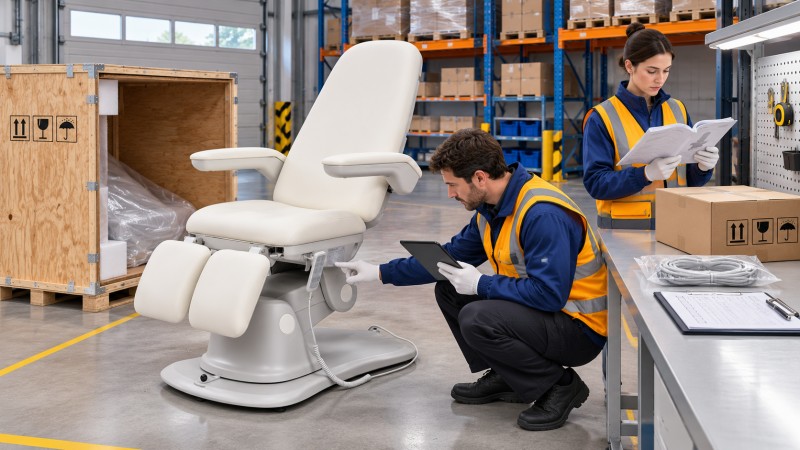
Verify regulatory documents, labels and configuration before resale
1. Define the destination country and the exact legal selling entity.
2. Approve one intended-use statement for that market.
3. Ask the local representative or adviser to confirm the classification in writing.
4. Identify who will own the registration and what happens if the distributor changes.
5. Confirm whether registration covers every model, voltage, control, accessory and private label.
6. Match the certificate, declaration and test-report model numbers to the quotation.
7. Verify that reports cover the complete chair, not only the motor, power supply or upholstery.
8. Approve label artwork and instructions before production.
9. Confirm local-language, importer-address and traceability requirements.
10. Add regulatory deliverables and substitution controls to the purchase contract.
11. Inspect a production sample against the approved compliance configuration.
12. Establish complaint, spare-parts, incident, recall and field-correction communication before launch.
The purchase specification should identify the destination, intended use and approved compliance configuration. A practical clause can state:
The supplied chair shall match the model, voltage, control system, components, labels, instructions and accessories covered by the approved technical documentation for the named destination market. No safety-critical component, intended-purpose statement, model identifier or regulatory label may be changed without the buyer's written approval and an assessment of regulatory impact.
Registration ownership also needs a written agreement. The manufacturer should retain access to technical and post-market data, while the local holder must provide timely notice of complaints, authority questions and field actions. A distributor should not discover after launch that a former agent controls the only active registration.
Not every chair follows the same FDA route. First determine whether the intended product is a medical device, identify its regulation, product code and class, and check whether premarket notification is required or exempt. Registration and listing are not the same as FDA approval or clearance.
No. CE marking supports access only under the European legislation that applies to the product. The United States, Canada, Brazil, Australia and Southeast Asian countries have separate systems and local economic-operator requirements.
Potentially, but the two routes need controlled intended purposes, labels, instructions, claims, technical files and SKU records. A beauty label cannot neutralize medical claims made by the distributor.
No. ISO 13485 is a quality-management-system standard. Certification can support regulatory submissions and supplier qualification, but it is not a product registration and does not prove that every model meets every country’s requirements.
Not automatically. It is relevant when the product is medical electrical equipment within the applicable scope. The manufacturer must document the standards assessment for the final design and target market. Beauty-only electrical furniture may follow a different product-safety standard.
No. Component evidence is useful, but authorities and importers evaluate the finished product and its interactions. The chair’s mechanics, wiring, controls, power supply, EMC, labels and accessories must be covered by the appropriate complete-product evidence.
The permitted holder depends on national law. Commercially, the agreement should address data access, renewals, change of distributor, complaints and transfer or replacement of the local representative. Registration ownership should be settled before launch, not after a relationship ends.
Send the destination country, medical or beauty intended use, customer type, model and options, voltage and plug, proposed private label, planned claims, expected order quantity and desired registration holder. Those details determine which documents and product variants should be quoted.
Do not begin with a shopping list of logos. Begin with the intended use, country, classification and responsible local company. Then build the product authorization, importer licence, technical evidence and post-market system around that decision.
For distributors, the safest commercial approach is usually to maintain a clearly controlled medical version and a clearly controlled beauty-only version. That makes quotations easier to compare, prevents unsupported claims, reduces customs and market-surveillance surprises, and gives the manufacturer a stable specification for production and after-sales support.


"*" indicates required fields


