
Upholstery affects much more than the appearance of a beauty bed or salon chair. It influences how the furniture feels during long treatments, how easily it can be cleaned, how well it handles repeated movement, and how long it maintains a professional appearance.
Salon furniture is exposed to demanding conditions, including:
Frequent client contact
Sweat and body oils
Facial products and massage oils
Shampoo, water, and steam
Makeup and hair color
Repeated cleaning and disinfection
Continuous bending around adjustable sections
PU leather, PVC leather, and microfiber leather are three common upholstery options for professional salon furniture. They may look similar in product photos, but their construction, texture, performance, and cost can vary considerably.
This guide explains the main differences and helps salon owners, distributors, and project buyers select the right material for different salon applications.
Before comparing performance, it is important to understand how each material is constructed.
PU leather is a synthetic upholstery material made by applying a polyurethane coating to a textile backing, usually a woven or knitted fabric.
It is widely used for:
Electric beauty beds
Facial chairs
Lash beds
Massage tables
Shampoo chairs
Salon stools
Waiting-area seating
PU leather is popular because it provides a practical balance of softness, flexibility, appearance, and price. It is also available in a wide range of colors, grains, and surface finishes.
However, the term “PU leather” covers many quality levels. Coating formulation, backing strength, thickness, surface treatment, and manufacturing quality all affect long-term performance.
PVC leather, also known as vinyl upholstery, is made by applying a polyvinyl chloride coating to a textile backing.
It is commonly used for furniture that requires:
Strong water resistance
Easy routine cleaning
Stable commercial performance
Competitive pricing
PVC upholstery is often found on pedicure chairs, shampoo units, stools, tattoo chairs, entry-level beauty beds, and medical-style treatment furniture.
Compared with PU, PVC usually has a firmer and less flexible surface. Its practical performance makes it suitable for high-use or moisture-heavy environments, although lower-grade PVC may feel more plastic-like or become harder over time.
Microfiber leather is generally made from very fine synthetic fibers formed into a dense nonwoven base and impregnated with polyurethane.
It is therefore not completely separate from PU technology. The main difference is the internal base structure.
Standard PU leather usually uses a woven or knitted textile backing, while microfiber leather uses a three-dimensional microfiber network designed to create a stronger and more leather-like structure.
Microfiber leather is often selected for premium furniture because it can provide:
A softer and more refined texture
Good flexibility
A natural leather-like appearance
Strong support around curved upholstery
A higher-end product presentation
Its more complex construction also makes it more expensive than most standard PU and PVC options.
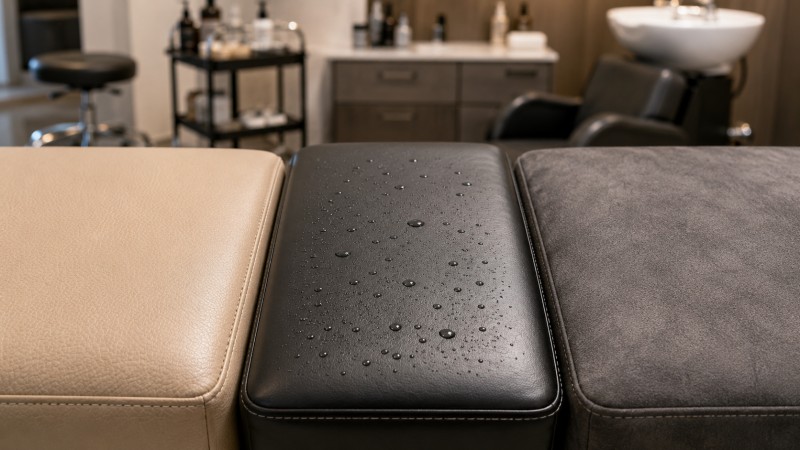
| Feature | PU Leather | PVC Leather | Microfiber Leather |
|---|---|---|---|
| Surface feel | Soft and flexible | Firmer and more structured | Soft and refined |
| Typical price | Mid-range | Entry-level to mid-range | Mid-range to premium |
| Water resistance | Good | Very good | Good, depending on finish |
| Flexibility | Good | Moderate | Very good |
| Cleaning | Easy with approved products | Generally easy | Easy with approved products |
| Appearance | Modern and customizable | Practical and consistent | Premium and leather-like |
| Curved upholstery | Well suited | Depends on the grade | Very well suited |
| Heat comfort | Generally comfortable | May retain more heat | Generally comfortable |
| Best application | Most salon furniture | Moisture-heavy or budget-focused furniture | Premium salon furniture |
| Main concern | Low-grade coating may peel | May feel firm or harden | Higher purchasing cost |
These are general market characteristics rather than fixed rules.
A commercial-grade PVC material can perform better than a low-quality PU. Similarly, an advanced PU upholstery can be more suitable for salon use than an untested microfiber material.
The material name should therefore be treated as the starting point, not the final quality standard.
When selecting upholstery for salon furniture, buyers should focus on the conditions in which the product will be used.
Comfort is particularly important for treatments that last one hour or longer.
PU and microfiber leather generally feel softer and more flexible than basic PVC. They are often preferred for beauty beds, lash beds, massage tables, and other furniture where clients remain in the same position for extended periods.
PVC can still be comfortable when combined with suitable foam and cushion design. Upholstery is only one part of the overall comfort level.
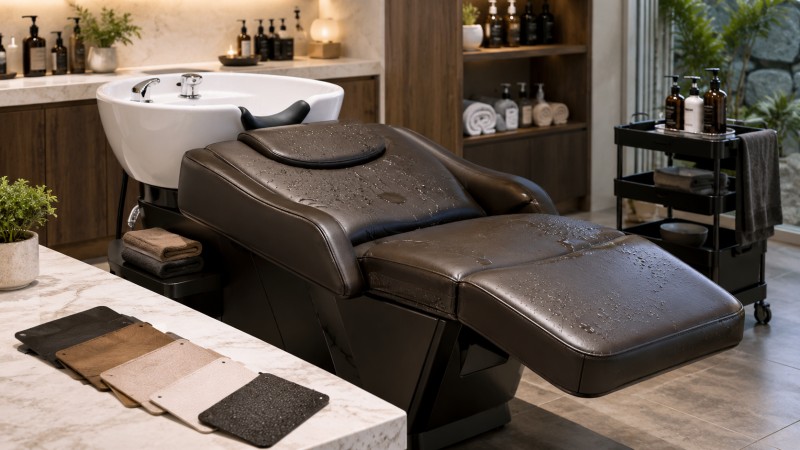
Head spa beds, shampoo chairs, and pedicure furniture are frequently exposed to water, steam, shampoo, lotions, and treatment products.
PVC typically provides strong surface water resistance. Suitable commercial PU can also perform well, provided that the finish, backing, and seams are designed for the application.
Furniture construction is equally important. Water should not be allowed to collect around:
Stitching
Zippers
Basin edges
Upholstery joints
Fixing holes
Moving sections
Even highly water-resistant upholstery cannot protect a cushion if liquid repeatedly enters through unsealed seams.
Electric beauty beds often include adjustable backrests, leg sections, headrests, seat angles, and split-leg structures.
The upholstery must bend repeatedly without placing excessive tension on the seams or corners.
PU and microfiber leather are generally well suited to adjustable furniture because of their flexibility. PVC can also be used, but the correct grade and cutting pattern are important, especially around deeply curved or frequently moving sections.
Salon furniture must be cleaned regularly, but not every synthetic leather can tolerate the same chemicals.
Performance depends on the complete upholstery system, including:
Surface coating
Protective topcoat
Pigments
Textile backing
Adhesive
Stitching
Surface texture
Some commercial materials are designed to tolerate specific disinfectants, while others may discolor, harden, crack, or peel when exposed to strong chemicals.
Buyers should request an approved cleaning guide rather than relying on broad claims such as “waterproof,” “medical leather,” or “easy to clean.”
Salon stools, waiting chairs, and high-volume treatment beds experience concentrated friction in the same areas every day.
Abrasion resistance is especially important for:
Seat centers
Backrest edges
Armrests
Leg sections
Areas near adjustment points
Upholstery around frequently used handles
A soft surface does not automatically mean low durability, and a firm surface does not always mean high durability. Test data and material construction provide a more reliable basis for comparison.
PU and microfiber leather usually offer more flexibility for premium textures, fine grains, matte finishes, and customized colors.
PVC is also available in many colors, but it is often selected for practical rather than luxury-focused product lines.
For white, beige, pink, or other light upholstery, buyers should pay attention to:
Denim dye transfer
Makeup staining
Hair color
Massage oils
Color migration
Cleaning marks
A light-colored beauty bed may look attractive in a showroom, but the selected material must be suitable for frequent commercial use.
The most suitable upholstery depends on the furniture type, treatment environment, target price, and expected level of use.
For most electric beauty beds, high-quality PU leather offers the best overall balance.
It provides sufficient flexibility for adjustable sections while maintaining a soft, modern appearance. It is suitable for facial treatments, waxing, permanent makeup, lash extensions, skin care, and general spa services.
Microfiber leather is appropriate for premium models where a softer texture and more refined finish are important.
PVC may be used for entry-level products or applications where water resistance and cost control are the main priorities.
Head spa and shampoo furniture require upholstery that can handle regular moisture exposure and frequent cleaning.
Commercial PVC is often practical in these environments because of its water-resistant surface. Properly selected PU can also be used, especially when a softer appearance is required.
The final choice should be considered together with basin design, seam placement, drainage, and water protection around the upholstered sections.
Pedicure chairs are exposed to lotions, water, massage products, and frequent daily cleaning.
PVC is a practical option for high-volume or budget-focused pedicure furniture. PU is suitable for salons that want a softer seat and more luxurious appearance.
Microfiber leather can be used for premium pedicure lounge chairs, but the selected surface finish should be verified for resistance to oils, lotions, and approved cleaning products.
For most salon stools, commercial PU or PVC is sufficient.
The upholstery should be evaluated together with:
Foam density
Seam strength
Seat shape
Gas-lift quality
Base stability
Caster performance
Using premium microfiber leather on a basic stool may increase the price without significantly improving its overall function.
PU leather is commonly used for waiting-area furniture because it offers a good combination of appearance, comfort, and color customization.
Microfiber leather can support a more premium reception design, while PVC may be appropriate for busy commercial spaces that prioritize simple maintenance.
A good-quality PU leather beauty bed is usually the most practical option. It delivers a professional appearance without pushing the initial investment too high.
Neutral colors are easier to coordinate with future furniture and interior changes.
Choose commercial PU or PVC with clear abrasion and cleaning specifications.
For high daily usage, documented performance is more important than achieving the softest possible surface.
Premium PU or microfiber leather can create a more refined client experience.
However, luxury appearance should not replace practical requirements. The upholstery must still be compatible with the salon’s cleaning procedures and treatment products.
PVC or durable commercial PU is often suitable because the furniture will be used frequently by different students.
Medium or darker colors may make daily maintenance easier than pure white upholstery.
A two-level product strategy can serve a wider market:
Commercial PU or PVC for standard models
Upgraded PU or microfiber leather for premium collections
This allows distributors to offer different price levels without changing the main furniture structure.
A single salon does not need to use the same upholstery grade on every item.
A practical combination may include:
Premium PU or microfiber leather for electric beauty beds
Commercial PU for reception sofas
Durable PU or PVC for stools
Moisture-resistant upholstery for head spa and pedicure areas
The colors can remain coordinated even when the technical materials differ.
Instead of asking only whether the furniture uses PU, PVC, or microfiber leather, request more detailed information.
Confirm the coating type and backing structure.
For microfiber leather, ask whether the material uses a true nonwoven microfiber base or whether “microfiber” is being used only as a marketing description.
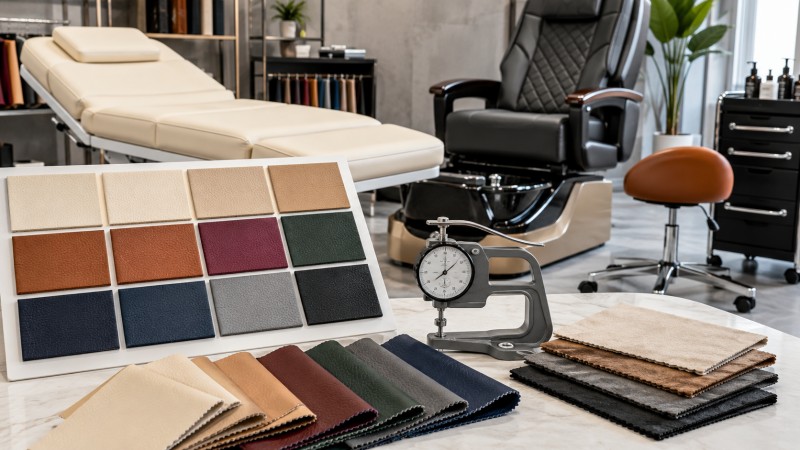
Ask whether the material has been tested using a recognized method such as Martindale or Wyzenbeek.
The number of cycles should always be provided together with the test method.
Hydrolysis resistance is especially important for PU materials used in warm or humid environments.
Poor resistance can contribute to surface breakdown, peeling, or loss of strength.
Request the recommended cleaning and disinfection instructions.
The supplier should be able to explain which products should be used and which chemicals should be avoided.
For light-colored furniture, ask about resistance to:
Rubbing
Denim transfer
Staining
Light exposure
Color migration
The backing affects stretching, tear resistance, seam stability, and performance around curved cushions.
The upholstery should also be inspected together with stitching quality and foam construction.
Custom upholstery colors may require a higher minimum order quantity than standard colors.
Always confirm the final color through a physical sample. Screen images can vary because of lighting, photography, and monitor settings.
Regardless of the selected material, correct maintenance can significantly extend the life of salon furniture.
Remove oils, cosmetics, and treatment residue promptly.
Use mild soap and water for routine cleaning unless the supplier recommends another method.
Follow the approved disinfectant instructions.
Test new cleaning products on a hidden area.
Avoid abrasive pads and stiff brushes.
Do not use concentrated solvents without approval.
Remove cleaner residue after disinfection.
Dry seams, folds, and cushion gaps after cleaning.
Avoid leaving wet towels or product-covered tools on the upholstery.
Inspect high-friction areas regularly for early signs of wear.
Cleaning damage is often caused by repeated chemical exposure rather than a single incident. A product that appears safe after one use may still affect the upholstery after months of daily application.
Terms such as “premium PU,” “medical leather,” and “nano leather” do not provide enough information to judge performance.
Buyers should request specifications, samples, and cleaning instructions.
Microfiber leather can improve the appearance and texture of premium furniture, but it may not be necessary for every product.
The material should match the furniture’s use, price position, and customer expectations.
A durable upholstery material may still fail if the salon uses unsuitable chemicals every day.
The actual cleaning routine should be considered before selecting the material.
Furniture durability also depends on:
Foam density
Stitching quality
Cutting accuracy
Adhesive quality
Cushion shape
Tension around corners
Frame and adjustment structure
Premium upholstery cannot compensate for poor cushion construction.
There is no single upholstery material that is best for every salon furniture product.
PU leather is the most balanced option for general beauty beds, facial chairs, lash beds, reception furniture, and adjustable salon equipment. It offers good flexibility, comfort, color options, and commercial value.
PVC leather is suitable for moisture-heavy, high-use, or budget-focused applications where water resistance and easy routine cleaning are priorities.
Microfiber leather is best suited to premium furniture that requires a softer feel, a refined appearance, and greater flexibility around complex upholstery shapes.
The final decision should be based on more than appearance or material name. Buyers should compare the upholstery structure, test information, cleaning compatibility, treatment environment, furniture design, and target market before approving an order.
Dongpin manufactures electric beauty beds, facial chairs, head spa beds, shampoo units, pedicure chairs, salon stools, reception furniture, and other professional salon equipment.
Upholstery colors and material grades can be selected according to the project design, target price, local market, and intended treatment environment. OEM, ODM, wholesale, distributor, and full salon project orders are also supported.
PU leather is generally softer and more flexible, which makes it suitable for adjustable beauty beds and longer treatments. PVC may be preferred when water resistance, frequent cleaning, or budget control is more important.
Microfiber leather normally uses polyurethane, but it has a more advanced nonwoven microfiber base. Standard PU leather more commonly uses a woven or knitted textile backing.
PVC is generally easy to wipe because of its water-resistant surface. Commercial PU and microfiber leather can also be easy to maintain when used with approved cleaning products.
PU, PVC, and microfiber leather can all be produced in white. The selected material should have good stain resistance, color-transfer resistance, and clear cleaning instructions.
Only when the material supplier specifically approves it. Repeated use of unsuitable alcohol-based products may cause discoloration, dryness, cracking, or peeling.
Commercial PVC and water-resistant PU are both suitable options. The choice should also consider seam placement, basin construction, water exposure, and cleaning procedures.
Distributors should request material composition, physical color samples, abrasion data, hydrolysis information, cleaning instructions, custom-color minimum order quantities, and warranty terms.


"*" indicates required fields


