
For a salon that only needs a place to wash hair between cutting and coloring services, a traditional shampoo chair may be all that is required.
For a business adding scalp treatments, head spa rituals or longer wellness services, the answer can be very different.
The difference between a shampoo chair and a shampoo bed is not simply whether the client sits or lies down. The choice affects how long a service can comfortably last, how much floor space the station occupies, what plumbing is required, how quickly staff can turn the station over and what kind of services the salon can realistically sell.
That is why the best choice should start with the service menu, not with which product looks more luxurious.
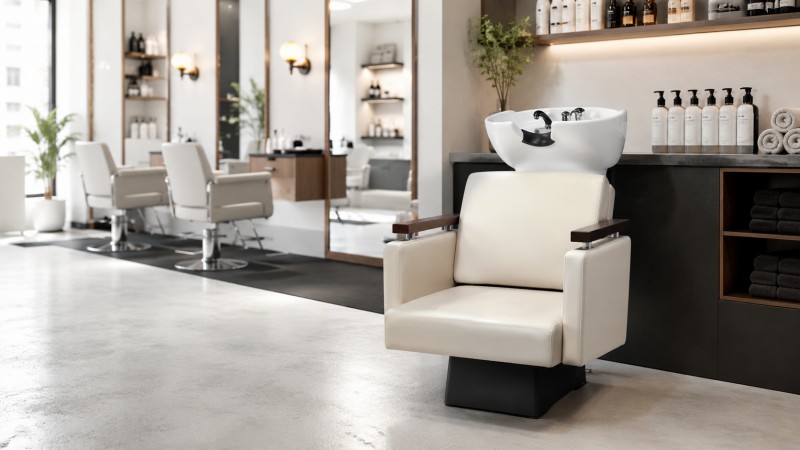
A traditional salon shampoo chair—often sold as a backwash unit—keeps the client in a seated or semi-reclined position with the shampoo basin directly behind the head.
It is designed around a familiar salon sequence:
Seat → Wash → Rinse → Return to Styling Station
This works especially well when washing is only one step within a larger hair service.
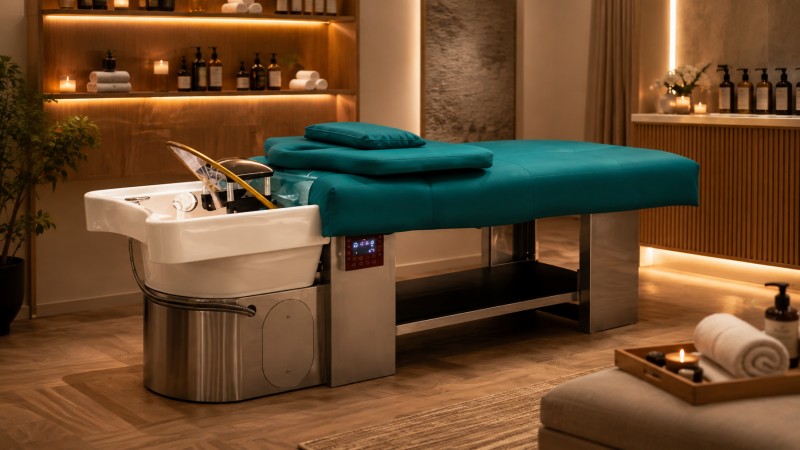
A shampoo bed changes the experience. The client's body is supported over a much larger surface, allowing shampooing or scalp treatments to become the service itself rather than simply a preparation step.
That difference becomes clearer when the two are compared by use rather than specifications.
| Consideration | Shampoo Chair | Shampoo Bed |
|---|---|---|
| Typical client position | Seated / semi-reclined | Reclined / lying |
| Best for | Hair washing, color rinse, quick scalp care | Head spa, longer scalp treatments, relaxation services |
| Service duration | Short to moderate | Moderate to long |
| Floor footprint | Smaller | Larger |
| Station turnover | Usually faster | Usually slower |
| Client body support | Mainly seat and back | Full or near-full body |
| Installation | Conventional backwash plumbing | Depends on model; fixed or self-contained options available |
| Service positioning | Support station | Can become a revenue-generating treatment station |
| Best business type | Hair salon, barber shop | Head spa, wellness spa, premium salon |
Neither format is automatically better.
The question is whether shampooing is a support function or a paid treatment category in your business.
The easiest way to choose between the two is to look at the service menu.
Imagine a salon where most clients book:
Haircuts
Hair coloring
Highlights
Blowouts
Basic shampoo and conditioning
In this business, the customer may spend only 10–20 minutes at the shampoo area before returning to the styling chair.
A full-length bed would occupy more floor area without necessarily increasing the value of the service.
A traditional backwash station is usually more practical.
Dongpin's DP-7825, for example, is a salon shampoo chair with a ceramic basin and an overall footprint of approximately 110 × 65 × 95 cm. Its compact chair-format design is aimed at standard washing and backwash applications rather than full-length head-spa positioning. (DP Beauty Furniture)
For a high-volume hair salon, this smaller footprint can be especially useful because several shampoo stations may need to fit along the same plumbing wall.
Now consider a different menu:
60-Minute Scalp Detox
Japanese Head Spa
Scalp Massage + Steam
Deep Cleansing Ritual
Hair & Scalp Wellness Package
Here, clients are not simply waiting for their hair to be rinsed.
They are purchasing time in the shampoo area.
A bed makes more sense because the client may remain there for 30, 45 or 60 minutes.
Dongpin's MH-C223 illustrates this difference. It uses a full-length flat bed configuration measuring approximately 200 × 67 × 65 cm, together with a ceramic basin and water-circulation system. The product is specifically positioned for head spa and longer wellness-oriented services. (DP Beauty Furniture)
In this type of business model, the larger footprint is not wasted space.
The shampoo bed is the treatment station.
A chair that is perfectly comfortable for a 10-minute shampoo is not necessarily the best furniture for a 60-minute scalp ritual.
This is one of the most useful distinctions when planning a service menu.
For shorter services, the client mainly needs comfortable neck positioning and enough support while the technician washes and rinses the hair.
As sessions become longer, additional areas become important:
back support → hip support → leg support → body position → ability to relax without repeatedly adjusting
This is where shampoo beds become more relevant.
Some modern shampoo beds also go beyond a simple flat mattress.
For example, Dongpin's XF-703 combines a reclining shampoo format with a cushioned backrest, water-resistant seating and optional features such as back heating and foot massage. It is designed for salons that want the shampoo station to become a more immersive treatment experience rather than only a rinse area. (DP Beauty Furniture)
The XF-705 follows a similar premium direction with an ergonomic full-body format and integrated massage features intended for longer scalp and hair-spa services. (DP Beauty Furniture)
That does not mean every head spa needs massage functions.
It means that once treatment duration increases, furniture selection should account for the client's entire body rather than only the neck and shoulders.
A salon owner may prefer the idea of a shampoo bed but discover that the room itself makes a chair more practical.
This is why product selection should happen alongside floor planning.
The difference between a 110 cm chair-format backwash station and a 200 cm shampoo bed is significant.
A shampoo bed requires room not only for the equipment itself but also for:
technician access around the basin,
plumbing or utility connections,
cleaning access,
product storage,
walking circulation,
nearby trolley or treatment equipment.
A bed pushed tightly between two walls may technically “fit” but create a poor working station.
By contrast, several conventional shampoo chairs can often share one service wall more efficiently.
Traditional shampoo stations generally need hot and cold water plus drainage at the installation point.
Many shampoo beds do too.
However, self-contained systems are creating another option.
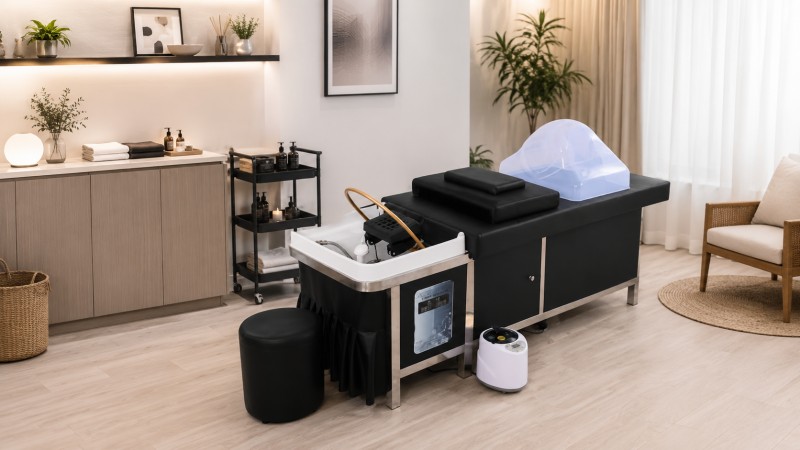
Dongpin's DP-B10 uses an internal 90-liter water tank and is designed as a non-plumbing head spa shampoo bed. The system includes water circulation and can be used without a permanent plumbing connection at the bed position. (DP Beauty Furniture)
That can be useful when:
converting an existing treatment room,
adding head spa services to a nail or beauty salon,
renting a space where plumbing changes are difficult,
testing a new service before remodeling.
But “non-plumbing” does not mean “no utilities or maintenance.”
Water still has to be filled, managed and discharged appropriately, and the equipment requires electricity and regular cleaning.
A shampoo chair may cost less and occupy less space, but those are not the only numbers that matter.
The more useful question is:
How much revenue is this station expected to generate per hour and per square foot?
Consider two simplified examples.
A shampoo chair handles four clients in one hour because each client only needs a short wash.
The station supports haircut, color and styling revenue.
Here, fast turnover matters.
A premium full-length bed could actually reduce efficiency if every shampoo becomes a longer transition.
A shampoo bed handles one client for 45–60 minutes.
But that client may be purchasing a complete premium scalp treatment rather than a basic wash.
Here, revenue per appointment and experience quality matter more than the number of clients passing through the basin.
The station has a different job.
This distinction is important when calculating return on investment.
Do not compare:
chair price vs. bed price
in isolation.
Compare:
station cost + floor space + service duration + selling price + expected daily bookings.
That produces a much more useful business decision.
Rather than declaring one product the winner, it helps to look at common business models.
A traditional shampoo chair usually makes the most sense.
Clients move between:
reception → styling chair → shampoo station → styling chair → checkout
The backwash area supports the main service rather than becoming a separate destination.
Compact dimensions and fast turnover are priorities.
A shampoo chair is generally the simpler solution unless the shop is intentionally developing premium scalp-care services.
A full-size shampoo bed may be difficult to justify in a traditional barber layout where floor space is already allocated to barber chairs and mirror stations.
A shampoo bed is usually the more natural starting point.
A model such as the MH-C223 supports full-length positioning and water circulation, while multifunction models can add massage, heating or other spa-oriented functions depending on the concept.
Here, the shampoo station is the primary treatment room equipment.
This situation is more interesting.
The salon may already offer:
facials,
nails,
lashes,
massage,
scalp treatments.
A non-plumbing shampoo bed can make it easier to test head spa services without redesigning the entire plumbing layout.
A salon could begin with one dedicated head-spa room and expand only after demand is proven.
Sometimes the right answer is both.
For example:
2–3 shampoo chairs for normal washing and color rinses
+1 shampoo bed for premium scalp and head-spa appointments
This allows the salon to keep high-volume services moving while creating a separate higher-value experience.
It is often a better solution than forcing every customer through the same station.
A multifunction shampoo bed may be more useful if scalp treatments are combined with massage or wellness rituals.
Dongpin's MH-C203, for example, combines head-spa water circulation with a separate foot-bath area, illustrating how the shampoo station can become part of a broader treatment package rather than only hair washing. (DP Beauty Furniture)
This type of product makes less sense for a salon that only needs five-minute rinses—but potentially much more sense for a business selling bundled wellness experiences.
Not universally. A shampoo chair is usually better for quick washes and high-turnover hair services. A shampoo bed is more suitable when shampooing, scalp care or head spa is a longer paid treatment.
Usually yes. A traditional backwash chair may be around 110 cm long, while full-length shampoo beds can approach or exceed 180–200 cm. Always compare actual product dimensions and technician clearance before planning the room.
Not every head-spa concept requires a full flat bed, but longer services generally benefit from greater body support. Reclining or full-length systems are therefore common in professional head-spa environments.
Some models can. The Dongpin DP-B10, for example, uses a 90L internal tank and is designed for installations without fixed plumbing at the bed location.
If shampooing is only part of haircut or color services, a compact shampoo chair is generally more space-efficient. If head spa is an important revenue category, allocating more space to one shampoo bed may still be worthwhile.
Yes. This can be an effective setup for full-service salons: shampoo chairs handle standard washing and rinsing, while a dedicated shampoo bed handles longer premium scalp or head-spa appointments.
Measure the complete station area rather than the furniture alone. Consider the product footprint, basin access, technician standing area, plumbing points, power supply, trolley position, walking path and door clearance.
A conventional shampoo chair can be straightforward when the salon already has backwash plumbing in place. A fixed shampoo bed may require more room and utility planning, while non-plumbing models can reduce construction requirements in some projects.
The most useful rule is simple:
If washing supports another service, start with a shampoo chair.
If washing and scalp care are the service, consider a shampoo bed.
For a traditional salon built around cuts, color and styling, the chair usually provides better turnover and space efficiency.
For a head spa or wellness business where the client remains at the station for an extended treatment, a shampoo bed can provide the positioning, comfort and service flexibility needed to create a higher-value experience.
And for larger salons, the best answer may not be chair or bed at all.
It may be:
standard shampoo stations for everyday services + one dedicated shampoo bed for premium head-spa appointments.
That allows the furniture layout to support the service menu instead of forcing every service into the same workflow.


"*" indicates required fields


