

At first glance, a split-leg facial bed and a podiatry chair can look surprisingly similar. Both may have separated leg sections. Both can help professionals access the client’s legs or feet more easily. Both are often adjustable, padded, and designed for treatment settings.
That is why many buyers, especially salon owners, waxing studios, med spas, and small treatment room operators, may ask the same question: is a split-leg facial bed basically the same thing as a podiatry chair?
The answer is no.
The biggest difference is not simply whether the chair has a split-leg design. The real difference is the type of service it is built for. A split-leg facial bed is mainly designed for beauty, spa, waxing, body care, and light aesthetic treatments. A podiatry chair is designed for professional foot care, clinical lower-limb treatment, and medical-style service environments.
Understanding this difference matters because the wrong chair can affect more than the treatment itself. It can change the feeling of the room, the way the provider works, the comfort level of the client, and even the type of customers a business attracts. A chair that works well in a foot care clinic may feel too clinical in a waxing room. A bed that feels comfortable and spa-friendly may not provide enough precision for professional podiatry work.
This guide breaks down the real difference between a split-leg facial bed and a podiatry chair, how each one is used, and how to choose the right option based on your business.
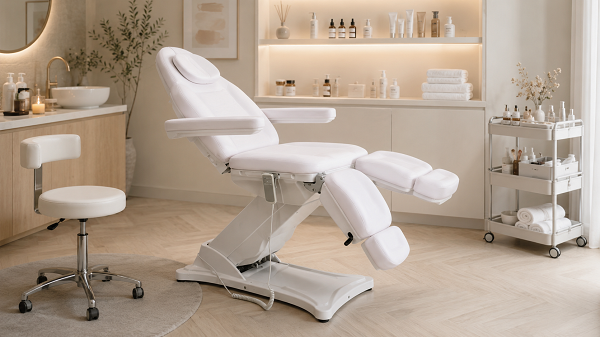
A split-leg facial bed is a beauty treatment bed with separated leg sections. Instead of having one continuous leg rest, the lower part of the bed is divided into two sections, allowing each leg area to be positioned or opened more flexibly depending on the design.
It is important to understand that a split-leg facial bed is still a beauty bed first. The split-leg structure does not automatically make it a medical chair. Its main purpose is to make beauty and body treatments easier, more comfortable, and more adaptable.
In beauty settings, clients often need to lie down, recline, turn slightly, or adjust their lower body position during a service. A traditional flat facial bed may work well for facials and massage-style treatments, but it may feel limited when the service requires better access to the legs, inner thighs, knees, or lower body. That is where the split-leg design becomes useful.
For example, in Brazilian waxing or full-leg waxing, the provider may need better access without asking the client to constantly shift positions. In some body treatments, one leg may need to be adjusted differently from the other. In light med spa services, the client may need to remain comfortable while the provider works around specific areas of the lower body.
This makes the split-leg facial bed a flexible choice for businesses that offer more than one type of service. It is commonly used in waxing studios, med spas, facial rooms, lash and brow studios, private beauty suites, body treatment rooms, and some tattoo or PMU spaces.
The design focus is usually comfort and versatility. A split-leg facial bed often has a softer, more spa-friendly appearance than a clinical chair. The padding, upholstery, shape, and overall look are usually meant to fit into a beauty room where clients expect privacy, relaxation, and a sense of care.
In simple terms, a split-leg facial bed is best understood as a multi-service beauty treatment bed with better lower-body access. It is not only about treating the feet or legs. It is about giving beauty professionals more flexibility while keeping the client experience comfortable and less clinical.
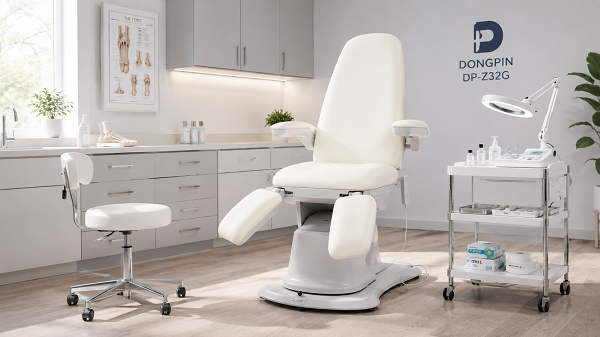
A podiatry chair is designed for foot care and lower-limb treatment. It is commonly used in podiatry clinics, foot care clinics, medical offices, diabetic foot care centers, rehabilitation facilities, nursing care environments, and professional foot treatment rooms.
Unlike a split-leg facial bed, a podiatry chair is not mainly created for spa comfort or beauty room styling. Its main purpose is to help a doctor, podiatrist, nurse, or foot care specialist work safely and precisely around the feet, toes, nails, heels, ankles, and lower legs.
This difference changes the entire design logic.
A podiatry chair often needs to support more controlled positioning. The provider may need to raise, lower, separate, or stabilize the patient’s legs in a very specific way. The chair must allow close access to the feet while keeping the patient stable. In many cases, the provider works while seated, so the chair has to support a workflow where the feet are positioned at a practical working height and angle.
Foot care can also involve longer sessions, detailed treatment, or clients with limited mobility. Some patients may be elderly, recovering, diabetic, or medically sensitive. Because of this, a podiatry chair often places greater emphasis on stability, safety, and strong support.
The appearance is usually more clinical. This does not mean uncomfortable, but the design priority is different. A podiatry chair is built to support medical-style treatment rather than create a spa atmosphere. It may look more functional, more structured, and more technical than a beauty bed.
This is why a podiatry chair is often the better choice when foot care is the main service. If a business focuses on toenail treatment, diabetic foot checks, medical foot examination, callus care, lower-limb support, or professional podiatry work, a dedicated podiatry chair usually provides a better workflow than a general beauty treatment bed.
In short, a podiatry chair is a clinical foot care chair. It is built around precision, access, support, and professional treatment efficiency.
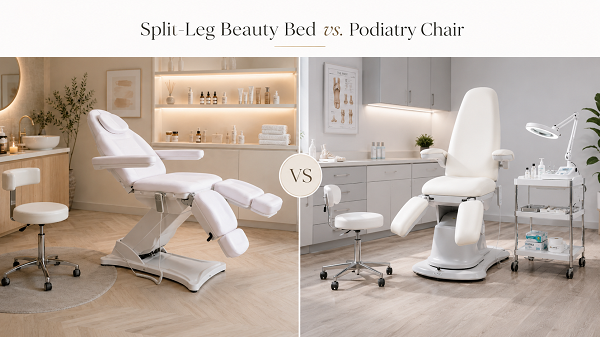
The main difference between a split-leg facial bed and a podiatry chair is not only the split-leg structure. It is the purpose behind the design.
A split-leg facial bed is made for beauty businesses that need flexibility. In a waxing studio, facial room, or med spa, one bed may be used for several services in the same day, such as facials, body waxing, and light aesthetic treatments. In this type of space, the bed needs to be comfortable, easy to adjust, and suitable for a beauty-focused room.
The split-leg design helps the provider access the lower body more easily, but the overall experience still feels like a beauty or spa treatment. The client is usually lying down, reclining, or resting in a relaxed position.
A podiatry chair is built for clinical foot care. The provider needs stable and controlled access to the feet, toes, nails, heels, and lower legs. This is important for foot exams, toenail care, diabetic foot checks, callus care, and other professional foot treatments.
In this setting, stability, leg support, working angle, and treatment precision are more important than creating a soft spa-like appearance.
The table below shows the difference more clearly:
| Comparison Point | Split-Leg Facial Bed | Podiatry Chair |
|---|---|---|
| Main Purpose | Beauty, waxing, spa, body care, and light aesthetic treatments | Podiatry, clinical foot care, and lower-limb treatment |
| Typical Business | Waxing studios, beauty salons, med spas, facial rooms, private beauty suites | Podiatry clinics, foot care clinics, medical offices, rehabilitation facilities |
| Design Priority | Comfort, flexibility, beauty-room appearance, and multi-service use | Stability, precision, patient support, and clinical workflow |
| Leg Function | Better lower-body access for beauty services | Controlled leg and foot positioning for treatment |
| Client Position | Lying, reclining, or semi-reclining | Seated, reclined, or positioned for foot-level access |
| Room Feeling | Soft, modern, spa-friendly, less clinical | Functional, medical, and treatment-focused |
| Best Use Cases | Brazilian waxing, leg waxing, facials, body treatments, med spa services | Foot exams, diabetic foot care, toenail treatment, medical foot care |
| Buying Logic | Best when one room needs to support multiple beauty services | Best when foot care is the main service |
This is why the two products should not be judged only by whether they have separated leg sections. A split-leg facial bed is about making beauty services more flexible and comfortable. A podiatry chair is about making foot treatment more precise, stable, and clinically practical.
For beauty businesses, a split-leg facial bed usually makes more sense because it supports different services while keeping the room comfortable and professional. For foot care clinics, a podiatry chair is usually the better choice because it is designed around clinical foot treatment.
The best way to choose between a split-leg facial bed and a podiatry chair is to start with your service menu, not the product name.
If your business is mainly beauty-focused, a split-leg facial bed will usually make more sense. This includes waxing studios, med spas, facial rooms, private beauty suites, and salons that need one bed for several types of services. In these settings, clients are not only paying for the technical service. They are also paying for comfort, privacy, and the overall feeling of the room.
For example, a waxing studio offering Brazilian waxing needs a bed that gives the esthetician better access while keeping the client as comfortable as possible. The room should still feel like a beauty space, not a medical examination room. A split-leg facial bed can support that balance because it provides lower-body access without creating a strong clinical atmosphere.
A med spa may also benefit from a split-leg facial bed if the services are mainly beauty-based. Treatments such as facials, body care, waxing, laser hair removal preparation, skin care, and non-invasive aesthetic services often need a flexible treatment surface rather than a dedicated foot care chair. In this case, the split-leg design adds useful positioning options without limiting the room to one narrow service category.
A podiatry chair is the better choice when the business is centered on foot care. If the main work involves podiatry, medical foot care, diabetic foot checks, toenail treatment, elderly foot care, foot examination, or lower-limb treatment, then a more clinical chair is usually necessary. These services require stronger positioning, better foot-level access, and a layout that supports the provider’s workflow.
This is especially important when foot care is not just an occasional add-on. If the provider works on feet every day, the chair needs to support that task repeatedly and safely. The client’s foot position, the provider’s sitting position, the stability of the leg sections, and the working height all become more important.
For businesses that fall somewhere in the middle, the decision depends on what service brings in the most clients. If foot care is only a small part of a broader beauty menu, a split-leg facial bed may be enough. If foot care is the main reason clients visit, a podiatry chair is usually the more practical long-term investment.
A simple rule can help: if your clients come for beauty treatments, choose the chair that supports comfort and flexibility. If your clients come for foot treatment, choose the chair that supports precision and clinical access.
One of the strongest use cases for a split-leg facial bed is waxing, especially Brazilian waxing and full-body waxing.
Waxing services require access, but they also require trust and comfort. Clients may already feel exposed or nervous, especially during intimate waxing. The treatment bed needs to support the provider’s work without making the room feel cold or medical.
This is where a split-leg facial bed can be useful. The separated leg sections allow more flexible lower-body positioning, which can make it easier for the esthetician to work around the legs and bikini area. At the same time, the client can remain supported on a padded, beauty-focused bed rather than sitting in a chair that feels designed for medical foot treatment.
For full-leg waxing, the provider may need to work around the front, side, and inner areas of the legs. A split-leg design can reduce some of the limitations of a standard flat bed. Instead of constantly working around one fixed leg platform, the provider has more room to position the client in a practical way.
The same logic applies to certain med spa services. Many med spas offer a mix of facials, skin care, body treatments, hair removal, and light aesthetic procedures. These rooms need furniture that can adapt. A treatment bed that only works well for one service may limit how the room is used. A split-leg facial bed allows a med spa to keep a professional beauty-room appearance while supporting different treatment needs.
Another advantage is room atmosphere. A podiatry chair may be very useful in a foot care clinic, but it can feel too clinical in a waxing studio or beauty suite. For beauty businesses, the emotional experience matters. Clients often judge the room before the service even begins. They notice whether the space feels clean, calm, comfortable, and appropriate for the treatment.
A split-leg facial bed usually fits this expectation better. It looks closer to a spa bed or facial bed, so it feels more natural in a beauty environment. The split-leg function is there when the provider needs it, but the overall impression remains beauty-focused.
This does not mean every waxing studio must use a split-leg facial bed. Some businesses may still prefer a traditional flat waxing table. But for providers who want better access, more positioning flexibility, and a more service-adaptable setup, a split-leg facial bed can be a strong option.
For beauty-based businesses, the value is not just that the bed has two leg sections. The value is that it supports real treatment situations while still fitting the way clients expect a spa or waxing room to feel.
A split-leg facial bed can replace a podiatry chair in some simple beauty-related situations, but it should not be treated as a full replacement for professional podiatry work.
The answer depends on what kind of service is being performed.
For basic foot or leg care in a beauty environment, a split-leg facial bed may be enough. A spa that occasionally provides light leg treatments, simple foot relaxation services, lower-body waxing, or beauty-based foot care may not need a full clinical podiatry chair. In these cases, the split-leg facial bed can offer enough access while still keeping the room comfortable and versatile.
It can also work well when the service is mainly beauty-focused and the foot or leg area is only part of the treatment. For example, a med spa offering body treatments or a waxing studio offering leg waxing does not usually need the same type of foot positioning used in a podiatry clinic.
However, a split-leg facial bed is not the right substitute for clinical foot care. If the service involves diabetic foot care, medical nail treatment, foot examination, professional podiatry, or high-frequency foot treatment, a dedicated podiatry chair is usually the better choice. These treatments often require more stable leg support, closer access to the feet, and more controlled positioning than a beauty bed is designed to provide.
This distinction is important for both safety and professionalism. A beauty treatment bed should not be marketed or used as a medical podiatry chair if it does not provide the same level of support. At the same time, a podiatry chair should not be assumed to be the best option for every service involving legs or feet.
For most beauty businesses, the question should not be, “Can this bed do everything a podiatry chair does?” A better question is, “Does this bed support the services I actually offer every day?”
If the answer is waxing, facials, body treatments, light med spa services, or general beauty care, a split-leg facial bed may be the more suitable choice. If the answer is professional foot care, clinical foot treatment, or medical lower-limb work, a podiatry chair is likely the better option.
A split-leg facial bed and a podiatry chair may look similar because both can have separated leg sections, but they are not designed for the same purpose.
A split-leg facial bed is built for beauty-focused businesses that need comfort, flexibility, and better access during services such as waxing, facials, body treatments, and light med spa procedures. It is a good fit for rooms where the client experience matters as much as the provider’s workflow.
A podiatry chair is built for professional foot care and clinical treatment. It is the better choice when the main service involves feet, nails, lower legs, diabetic foot care, or medical-style treatment. Its value comes from stability, precision, and support rather than spa-style appearance.
The right decision is not about which chair looks more advanced. It is about which one matches your daily services, your clients’ expectations, and the way your team actually works.
For a waxing studio, beauty salon, or med spa, a split-leg facial bed can offer a practical balance of comfort and access. For a foot care clinic or podiatry practice, a dedicated podiatry chair will usually provide the clinical support needed for professional treatment.
Start with the service first. The right chair choice becomes much clearer after that.
No. A split-leg facial bed and a podiatry chair may look similar because both can have separated leg sections, but they are designed for different environments. A split-leg facial bed is mainly used for beauty, waxing, spa, and med spa services. A podiatry chair is designed for professional foot care and clinical lower-limb treatment.
Yes. A split-leg facial bed can be a practical option for Brazilian waxing because it gives the esthetician better access while keeping the client supported and comfortable. It also fits better into a beauty or waxing room than a more clinical-looking podiatry chair.
It can be used, but it may not always be the best match. A podiatry chair can feel too clinical for a beauty salon, especially if the main services are waxing, facials, body treatments, or light aesthetic treatments. Unless professional foot care is a major part of the business, a split-leg facial bed is usually more suitable for a beauty-focused space.
For beauty-based med spa services, a split-leg facial bed is usually more versatile. It can support facials, waxing, body treatments, and light aesthetic services while maintaining a spa-friendly appearance. For medical foot care or lower-limb treatment, a podiatry chair is more appropriate.
Yes, but only for basic or spa-style foot and leg services. A split-leg facial bed may work for simple foot care, leg treatments, or beauty-based lower-body services. For professional podiatry, diabetic foot care, medical foot examination, or frequent foot treatment, a dedicated podiatry chair is usually the better choice.
They can look similar because both may use separated leg sections to improve access to the lower body. However, the design purpose is different. A split-leg facial bed uses this feature for beauty service flexibility, while a podiatry chair uses it for clinical foot positioning and treatment precision.


"*" indicates required fields


