

Swivel Base With Rotation Lock
When It Helps and When It Adds Risk
A practical workflow, safety and procurement guide for professional treatment chairs
September 21, 2026
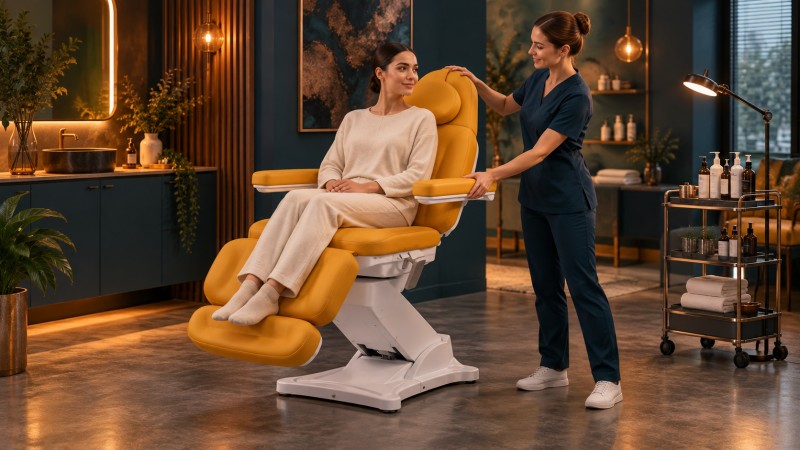
A swivel base can make a treatment chair easier to approach from different sides without moving the client, trolley or practitioner around the room. That is valuable when the treatment sequence genuinely requires changing access. Rotation is not automatically an upgrade, however. It also creates a movement envelope, another mechanism to inspect and a new way for the chair to move when the operator does not expect it.
For most professional buyers, the decision should be simple: specify a swivel base only when it solves a documented workflow or room-layout problem, and specify a positive rotation lock that operators can understand, reach, verify and maintain. If the chair must remain completely steady during precision work, client transfers or forceful body treatments, a fixed base may be the better choice.
A swivel base is most useful when a practitioner needs access to more than one side of the client, when a compact room has only one practical working zone, or when the client must face different equipment during one appointment. It may also help a shared room adapt to left- and right-handed operators.
Rotation adds risk when the chair can drift under lateral pressure, when the foot or back section can sweep into a trolley, wall, doorway or person, when cables cross the rotating interface, or when staff cannot tell whether the lock is fully engaged. The safest operating position for most procedures is normally the selected position with rotation locked, but the exact manufacturer's instructions for use always take priority.
Do not confuse a rotation lock with a motor lock, child lock, emergency stop or caster brake. These features control different hazards. A quotation that says only “lock function” is not specific enough for a B2B purchase.
The rotating part of a treatment chair is usually the seat assembly above a stationary floor base or pedestal. Depending on the model, rotation may be manual or powered, continuous or limited to a defined arc, and lockable at any angle or only at indexed positions. A limited swivel can be entirely adequate if it covers the operator's real working sides.
The rotation lock is the device that holds the upper chair at the chosen horizontal angle. It may use a mechanical pin, friction brake, hydraulic brake, electrically released brake or another manufacturer-specific system. The operator may control it with a lever, pedal, button or hand wheel. Some designs lock automatically after a time delay or when another powered movement begins; others remain released until the operator acts.
Those differences affect workflow and safety. A lock that can hold at any angle gives flexible positioning, while an indexed lock may be easier to verify because the chair settles into defined positions. Neither design is inherently superior. Buyers should compare holding performance, feedback, access and service requirements on the exact model.
Three terms are often mixed together:
· Rotation lock: prevents the seat assembly from swivelling around the vertical axis.
· Control lockout: disables powered adjustments such as height, backrest or legrest movement.
· Base or caster brake: prevents the complete chair from rolling across the floor.
A chair may include one, two or all three. Confirm each function separately.
Facial, medical-aesthetic, tattoo, permanent-makeup, podiatry and examination workflows can require access from different sides. Turning the chair can bring the treatment area closer to the practitioner's normal working position without asking the client to twist or forcing the operator to reach across the body.
This can support a more neutral working posture when rotation replaces repeated leaning or torso twisting. OSHA identifies awkward posture, prolonged reaching and repetitive twisting among ergonomic risk factors. Its ergonomics guidance supports evaluating the complete task rather than assuming that one furniture feature will solve the problem.
Rotation is useful only if the operator can still position the stool, knees, task light and instruments correctly after the chair turns. A rotating chair that merely transfers the awkward reach to another part of the setup does not improve the workstation.
In a small room, fixed cabinetry, plumbing, a magnifying lamp or a wall-mounted device may define where the practitioner can work. A limited swivel can turn the client toward that clear zone while the chair's base remains in its approved installation position.
The critical measurement is not the base footprint alone. The backrest, armrests, leg section, client's feet and accessories create a larger sweep as the chair rotates. The sweep also changes when the chair is raised, reclined or extended. Room planning should therefore test the full configured envelope, not just the upright catalog dimensions.
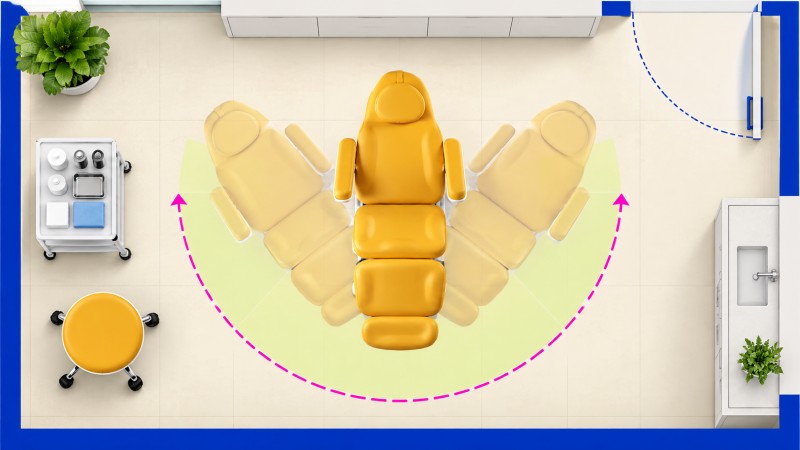
Treatment chair rotation sweep and room-clearance planning
Some services use more than one fixed device or visual focal point. The chair may face the consultation screen during intake, a task light during treatment and a mirror during review. Rotation can make those transitions simpler, provided all cables, hoses and accessories remain clear and the chair is locked again before work continues.
A modest left-right swivel can support practitioners who work from different sides. This is most effective when the lock control is reachable from both normal working positions and every operator follows the same release, rotate, re-lock and verification sequence.
During detailed facial, lash, tattoo, permanent-makeup or clinical work, even small unexpected horizontal movement can disrupt hand position. A well-designed swivel can remain stable when locked, but it adds joints, brake components and tolerances that a fixed base does not require. If the service rarely needs a different orientation, the simpler fixed design may offer a clearer operating state.
Massage, bodywork and some positioning tasks may apply repeated side loads to the chair. Buyers should not assume that a rotation lock is designed to resist every type of working force simply because the chair's vertical load rating is high. Load capacity and rotational holding performance are different specifications.
Ask the manufacturer whether the intended procedures are compatible with the swivel mechanism and how the lock should be tested. Never improvise a wedge, strap or aftermarket stop to compensate for a lock that does not hold as specified.
An unlocked chair can rotate when a client pushes on an armrest, foot section or seat edge. That movement may surprise the client or shift the expected handhold. Unless the exact instructions state otherwise, a conservative workflow is to align the chair, lower it to the approved entry position, engage the rotation lock and verify stability before the client sits or stands.
This principle appears in professional chair instructions. For example, Takara Belmont's Maxim operating manual directs users to lower the chair and lock rotation for client entry and exit, clear the surrounding area before rotation and lock the chair again after positioning. This is an example from another product, not a substitute for the Dongpin model manual.
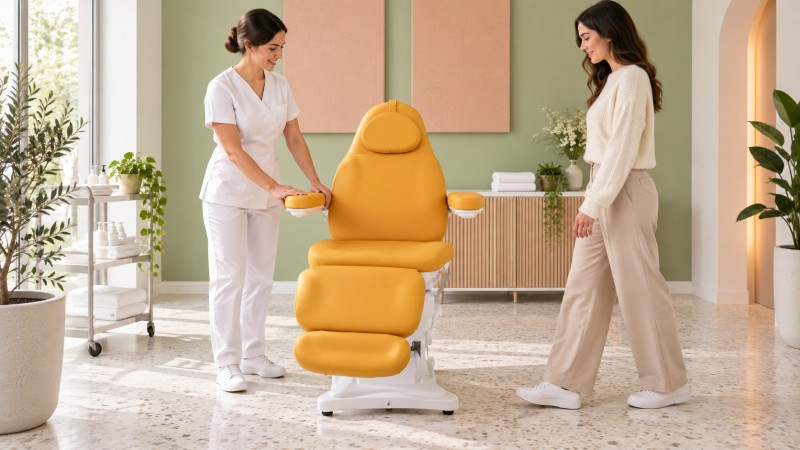
Locked and aligned treatment chair prepared for safe client entry
If the chair's sweep crosses a doorway, emergency route or staff walking path, rotation can create recurring conflicts. A fixed base or a different room layout may be safer and more efficient than relying on staff to reposition surrounding furniture for every appointment.
A chair may appear locked but not be fully seated in an indexed position. A worn brake, loose linkage, incorrect adjustment, contamination, damaged cable or installation problem may reduce holding performance. The operator needs an unambiguous way to confirm engagement, such as a defined lever position, tactile stop, audible click or status indicator documented by the manufacturer.
A small amount of free play is not automatically acceptable or defective; permissible movement depends on the mechanism and specification. If play increases, the chair does not hold the selected position, the lock intermittently releases or operation differs from the manual, remove the chair from service and request qualified inspection.
The rotating upper structure can contact trolleys, stools, lamps, walls, cabinets or people even though the base itself does not move. Risk rises when the backrest is reclined or the footrest is extended because the sweep becomes larger and harder to judge.
For medical-device applications, the FDA's safety communication on electrical operating room tables reports concerns involving positioning and unintended movement. It recommends following instructions, training staff, checking for obstructions, respecting load limits and completing recommended maintenance. Salon chairs are not operating room tables, but the documented control principles are relevant to powered and rotating equipment.
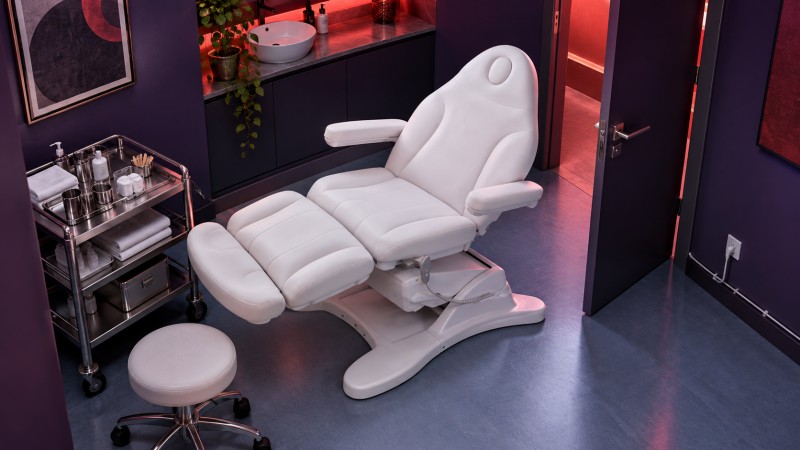
Unplanned treatment-chair rotation sweep near room obstacles
Rotation may create changing gaps between the seat assembly, pedestal, trim and nearby furniture. Keep hands, feet, clothing, cords and accessories away from the rotating joint and other moving structures. The location of hazards varies by design, so operators need the model-specific diagrams and warnings.
Power cords, hand controls, foot controls, heating cables and accessory hoses need a routing plan that remains safe through the approved rotation range. A cable can appear clear in the centered position but tighten, wrap around the column or enter a walking path after rotation. Buyers should ask whether a swivel joint, cable guide, rotation stop or restricted range protects the wiring.
A labelled lock control does not prove that the chair is safe for every procedure. The mechanism must be fully engaged, the base must be installed on the specified surface and the chair must be used within its intended configuration and load limits. A motor lockout also does not necessarily lock horizontal rotation.
The exact instructions for the purchased model remain authoritative. Where the manufacturer permits rotation with an occupied chair, a conservative general sequence is:
1. Inspect the floor, base, visible lock components, controls and cables before the first appointment.
2. Set the chair to the manufacturer's approved entry position and align it with the client's approach path.
3. Engage the rotation lock and confirm the chair does not move unexpectedly before entry.
4. Seat and position the client according to the product instructions.
5. Before rotation, tell the client what will happen and check the complete sweep for people, stools, trolleys, lamps, walls, doors and cables.
6. Release the rotation lock using the documented control. Guide the chair only from the approved handling points and rotate slowly within the allowed range.
7. Stop at the working angle, re-engage the lock and verify engagement before treatment or powered repositioning continues.
8. Keep rotation locked during the procedure unless the instructions and clinical workflow specifically permit another controlled change.
9. At the end, return to the approved exit orientation and height, lock rotation and confirm stability before the client stands.
Stop using the rotation function if the chair binds, rotates unevenly, makes a new grinding or clicking sound, fails to lock consistently, develops increasing play or damages a cable. Do not open the base or adjust a safety mechanism unless the manufacturer authorizes the procedure and a qualified person performs it.
Decision factor | Swivel base with lock | Fixed base |
Best workflow | Services needing planned access from multiple sides | Services performed from one stable working position |
Room planning | Requires full rotation-sweep clearance in every configured position | Requires clearance for powered articulation but no horizontal sweep |
Client entry | Must be aligned, locked and verified before entry | Orientation remains constant |
Precision stability | Depends on lock design, adjustment and condition | Fewer rotational components and a single operating state |
Operator posture | Can bring the work toward the operator | May require walking around or changing stool position |
Training | Requires release, rotation, re-lock and verification steps | Simpler orientation training |
Maintenance | Adds lock, bearing, stops and possible control components | No swivel-lock mechanism to service |
Best procurement case | Rotation solves a measured access or layout problem | Rotation would rarely be used or would cross hazards |
This comparison describes typical design consequences, not a universal performance ranking. A well-engineered swivel chair may be steadier than a poorly installed fixed chair. Compare the complete product, installation instructions and intended use.
Many appointments use one prepared position for most of the service. A fixed base can be sufficient when both sides remain accessible. Swivel becomes useful if the practitioner alternates between facial, neck and shoulder work or needs to turn the client toward fixed lighting or imaging equipment. Once positioned, the chair should remain locked for close hand work.
Rotation can improve access, but clinical governance, device classification and facility policy matter. Define who may release the lock, whether rotation is permitted with the patient seated, how monitoring lines and accessories are protected and which checks are documented. Do not infer medical suitability from the word “lock.”
Artists often work from several angles and may benefit from a limited swivel. The lock must resist the normal contact forces of the intended work without drift. Room tests should include the artist's stool, arm support, lamp, trolley and usual cable routing.
A rotating chair can bring each leg toward the operator while fixed equipment remains in place. Split leg sections, foot controls and rotation must not conflict. Confirm that the lock control stays reachable when the leg supports are raised, lowered, separated or extended.
If the bed is normally flat and the practitioner moves around it, rotation may add little value. A wide fixed table can provide a simpler, predictable platform. If one chair must support both seated facials and body services, test stability and clearance in the complete flat configuration before specifying swivel.
Treat the swivel system as a defined configuration item, not a decorative feature. Include the following questions in the request for quotation:
1. What is the exact usable rotation range, measured from the center position in each direction?
2. Is rotation manual or powered, and can the chair rotate while another motor is moving?
3. Does the lock hold at any angle or only at indexed positions? How many positions are available?
4. What control releases and engages the lock, and can it be reached from both working sides?
5. What visual, audible or tactile feedback confirms that the lock is engaged?
6. Is the default state locked or unlocked after power-up, power loss, emergency stop or inactivity?
7. Is there automatic re-locking? If so, what event or time delay triggers it?
8. What rotational play is permitted when locked, and how is it measured during inspection?
9. Which functions are disabled while rotation is unlocked? Is “rotation lock” separate from “control lockout”?
10. What floor conditions, anchoring, leveling or installation checks are required?
11. What inspection interval, cleaning method, lubrication, adjustment and replacement parts apply to the swivel and lock?
12. How are power and control cables protected through the full rotation range?
13. Which product standard, test report, electrical documentation and destination-market records apply to the ordered configuration?
14. Can the supplier provide a video showing release, rotation, re-locking and a stability check on the production model?
For fleet or distributor orders, request lock assemblies, pedals, switches, cables and wear components by exact part number. Confirm whether production revisions are interchangeable and whether replacement requires factory adjustment or calibration.
The sample or first production unit should be inspected before the balance of a large order is installed. Use the manufacturer's instructions and qualified personnel; do not create an improvised overload test.
· Confirm the model, base, rotation range and lock-control configuration against the approved quotation.
· Inspect transit fasteners, trim, cables, connectors and visible gaps before powering the chair.
· Install and level the chair on the specified floor surface.
· Operate the empty chair through its permitted rotation and articulation range while checking clearance.
· Verify every lock position and the documented feedback method.
· Test the entry and exit orientation with the actual room furniture in place.
· Repeat the operating check according to the manufacturer's rated-load and service procedure.
· Record unexpected play, noise, collision, cable strain or inconsistent engagement and resolve it before client use.
· Train every operator and retain the model-specific manual, maintenance record and spare-parts list at the facility.
The DP-8196 beauty care examination chair lists a manual bed rotation range of 45 degrees to the left and right, together with three powered adjustments. This limited arc can suit rooms that need controlled side access without full-circle rotation. The product page does not define the rotation-lock mechanism, so buyers should confirm the lock type, positions, operating sequence and permitted play in writing.
The DP-M13A3GS-5J multi-position salon treatment bed lists manual rotation from -70 to +70 degrees, five motors, two memory positions and control panels at several locations. Its broader rotation range illustrates why room-clearance planning must include the backrest, legrest, operator controls and accessories in every expected position. Again, request the exact lock and rotation instructions for the ordered configuration.
When requesting a project quotation, send the room plan, intended services, normal operator sides, doorway and cabinet locations, device and trolley positions, client-transfer needs, destination market and required documentation. Then contact Dongpin for a rotation and room-layout review instead of specifying only “360-degree swivel.”
For professional treatment use, a swivel chair normally needs a reliable way to hold the selected working position. The exact mechanism and operating rules depend on the model. Confirm whether the lock acts automatically or manually, where it can hold and how engagement is verified.
Not necessarily. A limited left-right range may cover the real working positions while reducing cable twist and preventing the chair from entering unnecessary areas. Choose the smallest range that supports the documented workflow and room layout.
A conservative default is to align, lower and lock the chair before entry or exit, but follow the exact manufacturer's instructions. The operator should confirm stability before the client uses the chair or armrests for support.
Only when the manufacturer permits it and trained staff follow the specified sequence. Inform the client, clear the sweep, guide the chair from approved handling points, rotate slowly and re-lock before treatment continues.
There is no universal acceptable amount. Some indexed mechanisms may have documented free play, while other locks should feel nearly rigid. Compare the movement with the manufacturer's tolerance. Increasing, intermittent or unexpected movement requires inspection before further use.
A rotation lock holds the chair's horizontal angle. A safety or control lockout may disable powered movements. A caster brake prevents rolling. Product terminology varies, so the supplier should map each control to its actual function.
Usually not as a generic accessory. The base, frame, wiring, center of gravity and safety validation are part of the chair design. Retrofit only with a manufacturer-approved assembly and written installation instructions for the exact model and production version.
Stop using the rotation function when the chair will not lock consistently, drifts during normal work, develops new or increasing play, binds, makes unusual sounds, exposes damaged parts or strains a cable. Arrange qualified inspection and do not bypass the lock.
A swivel base is valuable when it moves the client into a better working relationship with the practitioner, equipment and room. It is unnecessary when the service already works from one stable orientation. The rotation lock is what turns mobility into a controlled feature, but only when its state is obvious, its holding performance is appropriate and staff use it consistently.
For a B2B purchase, document the room sweep, operating sequence, lock behavior, permitted play, cable protection, maintenance and spare parts before approving the order. That evidence is more useful than choosing the model with the largest advertised rotation angle.
Editorial note: This article provides general equipment-selection and workflow information. Follow the manufacturer's instructions and the applicable safety, electrical, clinical and accessibility requirements in the destination market.


"*" indicates required fields


