

How to Verify the Motor Count on an Electric Beauty Bed Before You Order
A practical verification guide for salon owners, distributors, project buyers and procurement teams
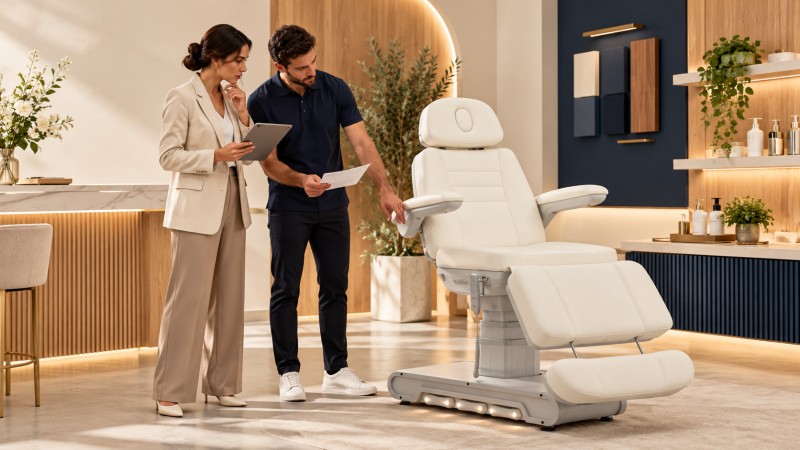
Verify the motor count before ordering an electric beauty bed
Motor count looks like a simple line on an electric beauty bed specification sheet. In practice, it is one of the easiest details to misunderstand. A handset may have ten or more buttons, one powered movement may use two synchronized lifting columns, and a chair with several adjustable sections may still leave rotation or extension manual. Heating, massage vibration and LED lighting add electrical components, but they are not necessarily positioning motors.
The short answer is this: do not verify motor count by counting buttons or visible movements. Verify the exact order configuration through a model-specific motion map, technical documents, accessible component identification, a continuous pre-shipment function video and written confirmation on the quotation or proforma invoice.
That evidence chain matters most in B2B purchasing. A showroom sample, catalogue image and bulk-production unit can look nearly identical while using different control systems or optional functions. The goal is not to inspect the supplier's engineering in unsafe detail. It is to make the ordered configuration measurable before the deposit, testable before shipment and traceable after delivery.
On most electric beauty beds, the powered movement is produced by a linear actuator, lifting column or related drive unit. The actuator extends or retracts and transfers force through the bed frame to raise the bed or change the angle of a section. A complete adjustment system also includes controls, cabling and typically a control box or power supply.
An actuator manufacturer’s system diagram can help buyers understand the architecture. For example, the LINAK linear actuator user manual shows a hand control connected to a control box and an actuator or lifting column connected to that control box. The handset is therefore an interface, not proof of how many actuators are installed.
Suppliers may use “motor” as a convenient commercial term, while an engineering document may use “actuator,” “drive,” “lifting column” or “channel.” Before comparing quotations, ask each supplier to define what the quoted count includes. A safe definition for your RFQ is:
Motor count means the number of electrically powered positioning actuators or lifting drives installed in the quoted unit. Heating elements, massage vibration units, pumps, fans, lighting and control interfaces must be listed separately unless the supplier clearly states otherwise.
This definition prevents an optional comfort feature from being mixed into the count of positioning drives.
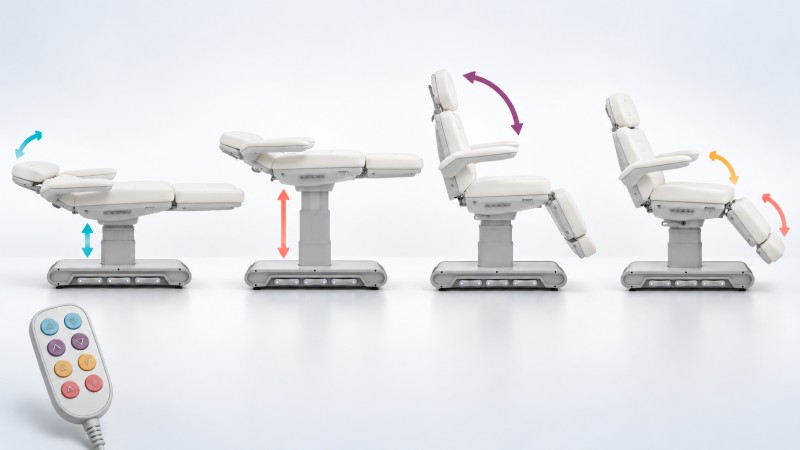
Control buttons and visible movements are not a reliable motor count
“Up” and “down” are two commands for the same axis. A handset with eight directional buttons may control four powered movements, not eight motors. Memory buttons, a reset button, a lock button or a light button increase the number of controls without adding another positioning actuator.
A broad lifting structure may use two synchronized drives for height. That means one visible function can account for two motors. Dongpin's five-motor M13A3GS-5J is a useful real-world example: the published specification assigns two motors to electric height adjustment, then one each to the backrest, legrest and seat tilt. The bed therefore has five motors but four powered adjustment types.
A mechanical linkage can make two sections appear to move together even when they share one drive. Linked motion may be exactly what a buyer wants, but it is different from independent control. The verification question is not only “does the leg area move?” It is “can this section move independently, and which actuator powers it?”
Headrest extension, foot extension, armrest swing and bed rotation are often manual even on a multi-motor chair. A product can legitimately offer many adjustable features while using fewer motors than the feature list suggests. Conversely, a five-motor bed can still have manual rotation. Do not assume that an adjustable feature is powered unless the specification explicitly says “electric.”
Heating pads, LED base lights, vibration modules, air pumps and USB outlets may share the bed's power system, but they should not automatically be counted as positioning motors. Ask for them as separate line items so pricing, testing, certification documents and spare parts remain clear.
Start with the work your treatment room needs, not the supplier's headline number. List every movement and identify whether it must be powered, independent or manual.
Movement or feature | What the buyer should specify | Evidence to request |
Height | Electric; number of synchronized drives if more than one | Motion map, component list and video |
Backrest | Electric or manual; angle range | Datasheet and full-range video |
Legrest or footrest | Electric, linked or manual | Separate button test and video |
Seat or whole-bed tilt | Electric or linked; direction and range | Side-view video and specification |
Rotation | Electric, hydraulic or manual; lock method | Written description and demonstration |
Extension sections | Manual or powered | Photo and operating demonstration |
Heating, vibration or lighting | Listed outside positioning motor count | Option code and separate function test |
This table becomes your baseline. If a quotation says “four motors” but does not map the four drives to the required movements, it is incomplete.
Never accept a generic family name as the full configuration. Record the model number, upholstery option, voltage and plug, control type, optional heating or lighting, and any country-specific electrical version. If the supplier uses a suffix for motor count or control package, include it on the commercial documents.
Ask whether the sample video shows the same revision as the unit being quoted. Product pages can be updated, and factories may offer more than one configuration under a related exterior design. The order should refer to the agreed specification attachment by filename or revision date.
For a serious B2B order, request enough information to cross-check the configuration without asking the buyer to dismantle the bed. A practical pack includes:
· A function-to-actuator motion map.
· A specification sheet stating motor quantity and the movement assigned to each drive.
· The user manual for the quoted control system.
· A simplified wiring or connection diagram showing actuator connections.
· A component or spare-parts list with actuator and control-box part numbers where available.
· Photos of accessible actuator, control-box or product identification labels.
The exact format varies by manufacturer. What matters is internal consistency: the movement list, connection diagram, component list and video should describe the same unit.
Control options are also separate from motor count. TiMOTION, for example, describes systems that can use hand controls, footswitches and nursing panels with a control box and software. Its operating-table actuator overview illustrates why several control interfaces can operate one actuator system without increasing the installed motor count.
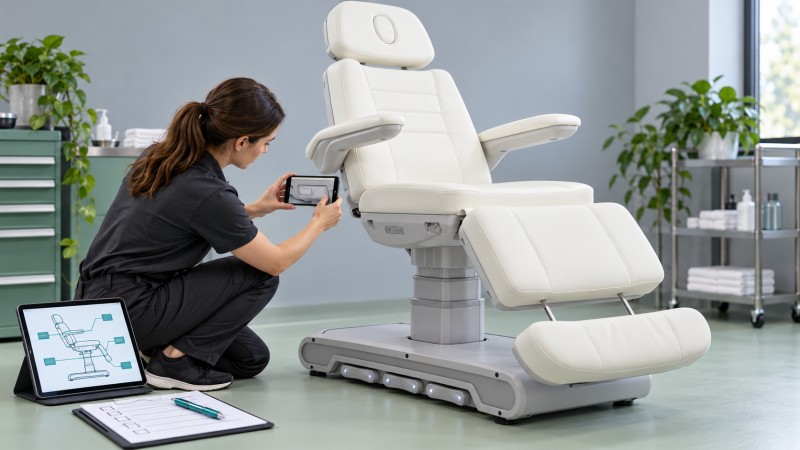
Match accessible component labels with the quoted configuration
Ask for clear, current photos or short video clips of labels that can be reached without removing protective covers. Depending on the design, useful labels may appear on the product rating plate, lifting column, actuator body, control box or cable identification tag.
Compare the visible model or part number with the manual and parts list. If a label cannot be photographed safely because the component is enclosed, request assembly records or a factory quality-control sheet instead. Do not instruct staff to open an energized base or crawl under a powered bed. Internal inspection should be performed only by trained personnel following the manufacturer's isolation and service procedures.
An exterior rating plate by itself may confirm voltage, power or product identity but not necessarily every actuator. Treat it as one piece of evidence, not the entire proof.
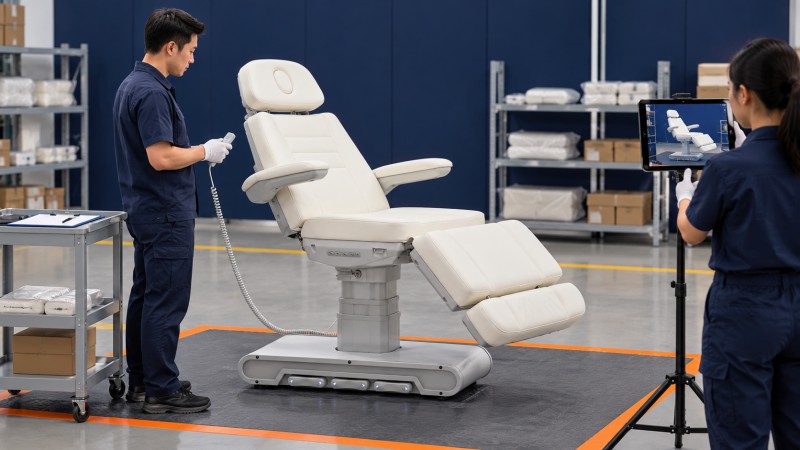
Record each powered movement in a continuous pre-shipment test
A useful video should identify the order and show the complete bed, not only close-ups of moving upholstery. Ask the factory to:
1. Show the model label, purchase-order reference or buyer-approved inspection card at the start.
2. Keep the full bed in frame from a stable side angle.
3. Operate one movement at a time through its normal range.
4. Pause between movements so the function can be identified.
5. Show independent movements separately rather than using a memory preset first.
6. Demonstrate every control interface included in the order.
7. Show manual functions such as rotation or extension separately and describe them as manual.
8. End with the bed returned to a safe neutral position.
If height uses two synchronized motors, the video may not allow a buyer to see both drives. That is why the motion map and component evidence are still required. Video proves behavior; documents help prove architecture.
Create one acceptance table with rows for motor quantity, powered axes, manual adjustments, control methods, voltage, options and label part numbers. Compare the website, quotation, specification sheet, manual, video and inspection report.
Common warning signs include:
· The product page says four motors, but the quotation only lists three powered axes and gives no explanation.
· The handset has a tilt icon, but the supplier says tilt is achieved only through linked backrest and legrest movement.
· Rotation is shown in photographs, but the commercial document does not state whether it is manual or electric.
· The video demonstrates a memory position but never shows the individual axes.
· The option list includes heating or vibration inside the claimed motor total.
· The label photos come from a different color, base design or model revision.
A contradiction does not always mean a defective or dishonest product. It may be an outdated page, a translation problem or an option mismatch. It does mean the supplier should resolve the discrepancy in writing before production.
Verbal confirmation is difficult to use during inspection. Add a clause such as this to the quotation, proforma invoice or specification attachment:
The supplied electric beauty bed shall contain five electrically powered positioning motors: two synchronized height-lift motors, one backrest motor, one legrest motor and one seat-tilt motor. Rotation and extensions are manual. Heating, vibration, lighting and control interfaces are excluded from the positioning motor count. The configuration shall match the approved specification and pre-shipment inspection sample.
Adjust the wording to the actual model. If the supplier does not use synchronized height drives, remove that phrase. The value of the clause is its precision, not the example number.
Motor count is not a universal shorthand for a fixed set of functions. These published Dongpin examples show how the count must be read together with the motion assignment.
Published example | Stated configuration | What a buyer should learn |
The official best-sellers article describes three separate motors for backrest, legrest and height | Confirm whether those are the three axes in the exact current quotation and whether tilt is linked or unavailable | |
Four motors for backrest, footrest, height and overall tilt | The fourth motor has a clear workflow purpose; rotation and foot extension are listed separately | |
Five motors: two for height, one for backrest, one for legrest and one for seat tilt; rotation is manual | Five motors do not equal five different powered movement types; one axis uses two motors |
These examples are not a rule that every three-, four- or five-motor bed follows the same architecture. They demonstrate why a model-specific function map is more valuable than a count alone.
Copy the following questions into an RFQ or supplier email:
· What is the exact motor or actuator quantity in the quoted model?
· Which movement does each motor control?
· Does any movement use two synchronized motors?
· Are any sections mechanically linked?
· Which adjustments are manual, including rotation and extensions?
· Are heating, vibration, pumps, fans or lighting excluded from the motor count?
· What actuator and control-box brands and part numbers are used in this order configuration?
· Can you provide the model-specific manual, motion map and connection diagram?
· Can the unit be tested one axis at a time in a continuous pre-shipment video?
· Will the verified motor allocation be written into the quotation and inspection standard?
· Are replacement actuators and control components available by part number?
· If a component brand changes, what approval process applies before substitution?
For distributors and multi-location projects, also request a spare-parts cross-reference. A bed may perform correctly on arrival, yet a future service team will still need to know which actuator belongs to which axis and which control-box output it uses.
Motor-count verification does not end at shipment. On receipt, inspect a sample from the actual batch before distributing or installing all units.
First, compare carton labels, model plates and option codes with the purchase documents. Check for transport damage before applying power. Follow the supplied assembly and electrical instructions, confirm the local supply matches the product rating, and keep people and objects clear of moving sections.
Then test one axis at a time without a client on the bed. Listen for unusual noise, watch for asymmetric lift or interference, and confirm that each button corresponds to the approved motion map. Test memory or reset functions only after individual movements have been verified. Record the unit serial number and results.
Stop testing and contact the supplier if a movement is jerky, the frame binds, two sides lift unevenly, a control command operates the wrong section, a cable is damaged, a label does not match the documentation, or a function moves beyond the expected limit. Do not keep cycling the unit to “see if it improves.”
There is no single correct number. Choose the powered movements your treatments and staff need. A three-motor configuration can be sufficient when its axes match the workflow; a fourth or fifth motor is useful only when it adds required movement, supports the lifting architecture or improves repeatable positioning.
No. Tilt is common on many four-motor models, but motor allocation is not standardized across the industry. The fourth drive could serve another section. Confirm the model-specific motion map.
Yes. A height mechanism may use two synchronized drives. The M13A3GS-5J published specification is one example: two of its five motors are assigned to height adjustment.
It should not be assumed. Define “motor count” in the RFQ as electrically powered positioning actuators and require vibration, heating, pumps, fans and lighting to be listed separately.
No. Two buttons can control one axis, while memory, reset, lock and lighting buttons add commands without adding actuators. Multiple hand, foot or panel controls may operate the same system.
Not as a routine buyer check. Removing covers can expose pinch points or electrical components and may affect warranty conditions. Prefer model-specific documents, accessible labels, factory records and a continuous function test. Internal inspection belongs to trained service or quality personnel using approved isolation procedures.
No single item is perfect. The strongest practical evidence is a consistent set: signed specification, function-to-actuator map, model-specific manual or connection diagram, accessible label evidence, continuous pre-shipment video and a purchase document that states the motor allocation.
Motor count is useful only when it is attached to a verified motion architecture. Before you compare price, translate the headline number into four questions: what moves, what powers it, what remains manual, and what evidence will be used for acceptance?
When those answers are written into the order, the motor count stops being a marketing claim and becomes a testable specification. That reduces option errors, makes factory inspection clearer, helps after-sales teams identify parts and gives buyers a more reliable basis for approving a sample or bulk shipment.


"*" indicates required fields


