
MAINTENANCE & TROUBLESHOOTING GUIDE
Why Does a Hydraulic Beauty Bed Slowly Sink?
Causes, Checks and When to Stop Using It
DP Beauty Furniture Technical Team | Technical review: September 3, 2026
Why Does a Hydraulic Beauty Bed Slowly Sink? Causes, Checks and When to Stop Using It
A hydraulic beauty bed that gradually loses height is not just an inconvenience. It can disrupt a facial, lash, waxing or aesthetic treatment, change the practitioner's working posture and, if the movement becomes unpredictable, create a client-transfer or positioning risk.
A hydraulic beauty bed usually sinks because the height-control valve is not closing fully, hydraulic fluid is bypassing worn internal seals, or fluid is escaping externally. Apparent sinking can also come from a soft or uneven floor, loose mounting points, or cushion compression. If the rigid chair frame continues to move downward, the bed cannot reliably hold its set height, or you find fresh fluid or structural looseness, remove it from client service and arrange a qualified inspection.
Safety scope: This guide covers non-invasive checks that a salon owner, distributor or facilities team can perform without opening the hydraulic pump. It is not a seal-replacement or hydraulic repair procedure. The product manual and the manufacturer's service instructions always take priority.
On a typical foot-pump beauty bed, repeated strokes of the pump pedal move hydraulic fluid into the lifting mechanism and raise the chair. A separate release pedal or lever opens a controlled return path so the chair can lower. When the release control returns to its resting position, the valve should close and retain the fluid needed to hold the selected height.
If fluid slips past a valve or an internal seal, the lift post can retract slowly under load. Hydraulic troubleshooting references call this movement drift or creep. The visible symptom may look simple, but the leak path can be inside the pump or cylinder and leave no oil on the floor.
The DP-8222 shown in this article is a foot-operated hydraulic beauty chair with a segmented top and mechanical backrest and leg-rest adjustments. The same diagnostic logic applies broadly to similar hydraulic facial chairs, but control layouts, load ratings and service parts vary by model.
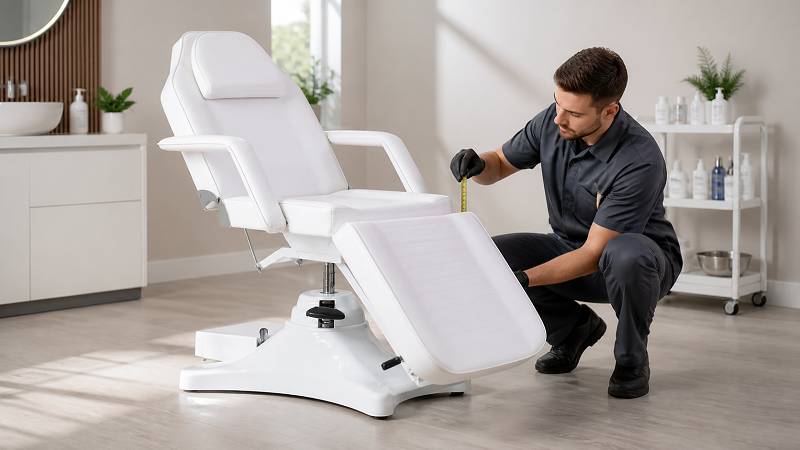
Before assuming the hydraulic unit has failed, measure from a rigid point on the chair frame or seat platform to a fixed reference. Do not measure from the top of the cushion: foam and upholstery compress when a person sits down and can create the impression that the entire bed has lowered.
Also check the floor. A base can rock or settle on thick carpet, a soft mat, an uneven tile joint or a loose floor panel. That is a stability problem that must be corrected, but it is different from the chrome lift post retracting into the hydraulic base.
Useful observations include:
· Does the rigid seat platform move, or only the cushion?
· Does the exposed lift post become shorter as the seat lowers?
· Does the movement happen with the bed empty, only under load, or immediately after the release pedal is used?
· Does the base stay flat and stable while the seat moves?
The lowering pedal may be held slightly open by debris, a floor mat, a bent linkage or a control that does not return freely. Even a small opening can let fluid return gradually. A pedal that feels sticky, has lost its normal travel, or remains partly depressed needs service; it should never be tied, wedged or forced into position.
Seals and internal valve surfaces wear over time. Contamination can also score a sealing surface. When fluid bypasses internally, the chair may sink without any visible external leak. General hydraulic service guidance lists internal cylinder bypass, worn or damaged seals, valve leakage and incomplete valve closure among the recognized causes of load drift.
This is a technician-level diagnosis. Do not disconnect fluid lines or pressurize an opened component to test it in a salon.
Fresh oily residue on the lift post, around the pump body, beneath the base or at an accessible connection is a clear fault signal. A dark stain from old cleaning product is not proof of a hydraulic leak, so blot the area with a clean white cloth and document what you find. Do not taste, smell closely or handle unknown fluid with bare skin.
Repeatedly pumping the chair back up does not repair a leak. It can hide the symptom long enough for the bed to be put back into service without addressing the cause.
Every beauty bed has a model-specific working limit and an intended pattern of use. Client weight is only part of the load. A person sitting on an armrest, stepping on the leg section, dropping onto the chair or applying force during a treatment can create concentrated or dynamic loads that are very different from a client lying still.
Do not use a catalog capacity from another model. Check the rating label, manual or supplier confirmation for the exact product and configuration.
Loose fasteners between the chair top and hydraulic base, worn pivot points, a damaged floor contact or play in the swivel mechanism can make the chair feel as if it is sinking. Watch the junctions while another trained person applies only light, controlled pressure to the empty chair. If metal parts shift, a mounting point moves or the base rocks, stop the check and tag the bed out of service.
Dust and debris around a control, impact during relocation, incorrect assembly, side-loading, corrosion, or the use of an incompatible fluid during an earlier repair can affect hydraulic performance. A problem that begins immediately after delivery, moving or service should be documented before anyone attempts an adjustment.
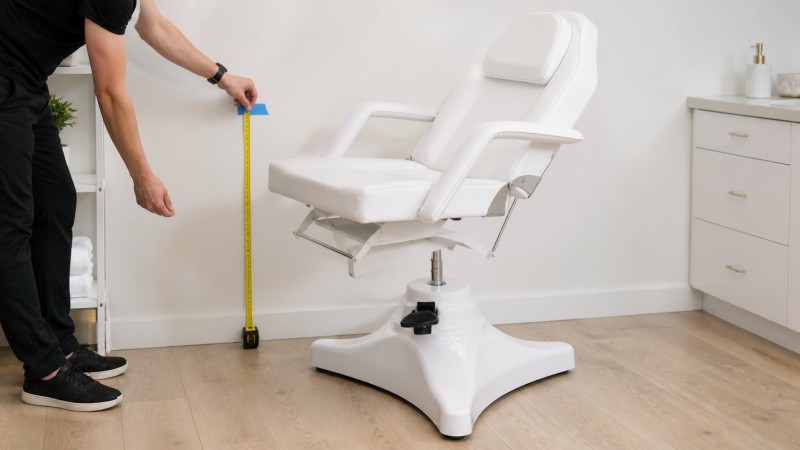
Use a rigid reference point, an empty chair and a level hard floor.
1. Pause client use while you assess the problem. Keep people off the bed and clear the area around the base.
2. Identify the exact model. Photograph the model/serial label and find the correct manual, load information and warranty terms.
3. Place the bed on a clean, hard and level floor. Remove mats or objects that could touch a pedal or let the base rock.
4. Inspect the controls. With the chair empty, confirm that the pump and release pedals move through their normal range and return without obstruction. Do not force a control.
5. Set a repeatable reference. Raise the chair to a mid-range working height. Measure from the floor to a rigid frame point, or align that point with removable painter's tape on a nearby wall. Record the starting position and time.
6. Observe the empty chair. Keep hands and feet away from pinch points. If the rigid frame lowers, record a short video showing the reference point, lift post and controls.
7. Look for accessible external evidence. Use good lighting to inspect the lift post, pump housing, base perimeter and floor. Check for fresh fluid, loose or missing hardware, cracks, distortion or unusual movement. Do not remove covers.
8. Do not reproduce an under-load failure with a client. If the bed holds empty but reportedly sinks during use, give that information to the supplier or technician. Use a test load only if the manufacturer provides a specific procedure and trained personnel can carry it out safely.
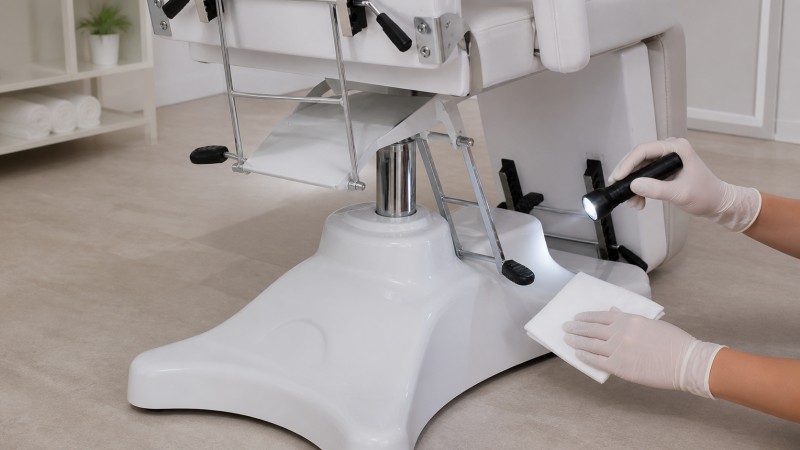
Look for visible evidence without removing covers or loosening hydraulic connections.
What you observe | More likely explanation | Appropriate next step |
Cushion compresses but the rigid platform stays fixed | Normal foam compression or upholstery movement | Measure from the frame; monitor for other symptoms |
Entire chair rocks but lift-post height is unchanged | Uneven/soft floor or unstable floor contact | Stop use until the base is stable on an approved level surface |
Chair lowers after the release control was used | Valve/control may not be returning or closing fully | Check for obstruction; arrange service if it repeats |
Rigid frame lowers with no visible fluid | Possible internal valve or seal bypass | Remove from client service and request a technical diagnosis |
Fresh oily residue appears at the post, pump or floor | External hydraulic leak | Stop using immediately; contain access and request service |
Metal joint, mounting point or base shifts | Loose, worn or damaged structure | Stop using immediately; do not tighten blindly without the model procedure |
Stop client use immediately if any of the following is present:
· The chair drops suddenly, moves unpredictably or will not hold the selected height.
· The rigid seat platform shows repeatable downward drift.
· Fresh hydraulic fluid appears on the lift post, pump housing, base or floor.
· The pump or release control sticks, fails to return, feels damaged or produces abnormal movement.
· A mounting point is loose; a weld, casting or base component appears cracked, bent or distorted; or the chair rocks despite a level floor.
· You hear grinding, cracking or new metallic noises.
· The bed has been overloaded, struck, dropped or incorrectly assembled and has not been inspected.
· The movement could affect a client's transfer, body position, airway access or the practitioner's control of a procedure.
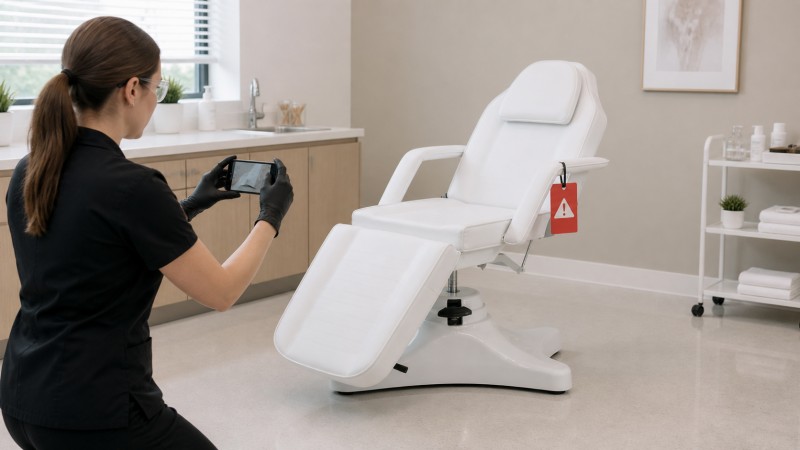
Prevent accidental reuse and document the condition before any repair.
Attach a clear out-of-service notice, prevent accidental use and keep the chair in a stable low position if the manufacturer permits. Do not rely on verbal handover between shifts.
· Do not keep raising the chair during a treatment to compensate for drift.
· Do not open the pump, loosen hydraulic connections or remove the cylinder under load.
· Do not add generic hydraulic oil, brake fluid or lubricant. Fluid type, fill method and bleeding procedure are model-specific.
· Do not clamp, tie or wedge the release pedal closed.
· Do not use a person as a test load.
· Do not assume that “only a few millimeters” is acceptable. There is no universal online drift allowance for all beauty-bed designs.
· Do not authorize a seal-only repair until the technician has considered valve condition, contamination, alignment and the reason the original part failed.
A useful service request helps a manufacturer or distributor distinguish an operating issue from a pump, valve, installation or structural fault. Include:
· model and serial number;
· order number and delivery date, if available;
· a full-chair photo from the front and side;
· close photos of the base, lift post, foot controls and any residue;
· a short video with a fixed height reference;
· whether drift occurs empty or only under load;
· the approximate starting position and elapsed observation time;
· recent events such as relocation, impact, assembly or prior repair;
· confirmation that the bed is on a hard, level floor and no object is touching a control.
Avoid sending a technician only the message “the chair is broken.” Clear evidence reduces back-and-forth, supports warranty review and helps the correct replacement part travel with the service visit.
Follow the inspection and maintenance intervals in the model manual rather than applying a generic schedule to every chair. As part of routine opening checks, keep the base area clean and dry, ensure controls are unobstructed, and look for new residue or movement. Recheck the chair after transport, room renovation or reassembly. Train staff not to sit on armrests or leg sections and not to move the bed by pulling on upholstered sections.
For multi-site operators and distributors, record each unit's model, serial number, installation date, location, inspection history and replacement parts. That simple asset record makes recurring faults visible and improves spare-parts planning.
A serviceable pump or seal problem does not automatically justify replacing the entire chair. Ask for the diagnosis, part availability, labor and freight cost, warranty coverage, expected downtime and post-repair test method. Replacement becomes more reasonable when structural damage is present, the correct hydraulic assembly is unavailable, repeated failures disrupt booked treatments, or several wear points are approaching end of life.
When specifying new equipment, compare more than purchase price. Confirm the published working limit, stable floor footprint, control layout, replacement-pump availability, warranty process, manuals and the evidence a supplier needs for after-sales support. You can review DP Beauty Furniture's hydraulic beauty bed range and the DP-8222 product configuration for relevant examples.
Cushion compression is normal; continued movement of the rigid chair frame is not something to dismiss. Because designs differ, there is no universal acceptable drift figure. If the frame cannot maintain the selected height, pause client use and follow the model-specific service process.
An internal leak can become more apparent under load. Overloading, concentrated force or using the chair outside its intended treatment conditions can also contribute. Do not repeat the test with a client. Verify the exact load information and report the under-load symptom to a qualified technician.
Low fluid may accompany an external leak, but a chair can also drift because fluid bypasses an internal seal or valve. Adding oil without finding the cause may overfill the unit or introduce incompatible fluid and contamination. Use only the manufacturer's service procedure.
You can perform the non-invasive checks in this guide, but opening a loaded hydraulic assembly, disconnecting lines or replacing seals requires the correct parts, tools and test method. For a commercial treatment chair, use an authorized or otherwise qualified service technician.
It should remain stable for its intended use, but manufacturers do not publish one drift tolerance that applies to every pump and chair. Follow the test in the correct manual. Any repeatable downward movement that changes treatment height or client position warrants service review.
Send the model and serial number, proof of purchase, photos, a video with a fixed reference, the conditions in which drift occurs and any recent transport or repair history. Do not disassemble the chair before the supplier confirms the warranty process.
Slow sinking is a symptom, not a diagnosis. Confirm that the rigid frame is moving, keep the assessment non-invasive and stop using the bed whenever height control or structural stability is uncertain. For model identification, replacement-pump questions or documented after-sales support, contact DP Beauty Furniture with the photos and observations listed above.
Reference 1. Parker Hannifin, Mobile Cylinder Service Manual, “Troubleshooting Hints” and “Cylinder not Holding Load or Drifts.” https://www.parker.com/content/dam/Parker-com/Literature/Mobile-Cylinder/hy18-0008-service.pdf
Reference 2. Living Earth Crafts, Napa User Manual, safety, operation, maintenance and troubleshooting guidance for a professional hydraulic treatment table. https://www.livingearthcrafts.com/media/wysiwyg/Manuals_User-Guides/2021/Napa_User_Manual_-_062921_1-400-0033.pdf


"*" indicates required fields


