

Working Load vs. Static Load: How to Read Beauty Bed Weight Ratings
A practical guide for spa owners, med-spa buyers, distributors and project teams comparing the load claims on electric, hydraulic and fixed beauty beds.
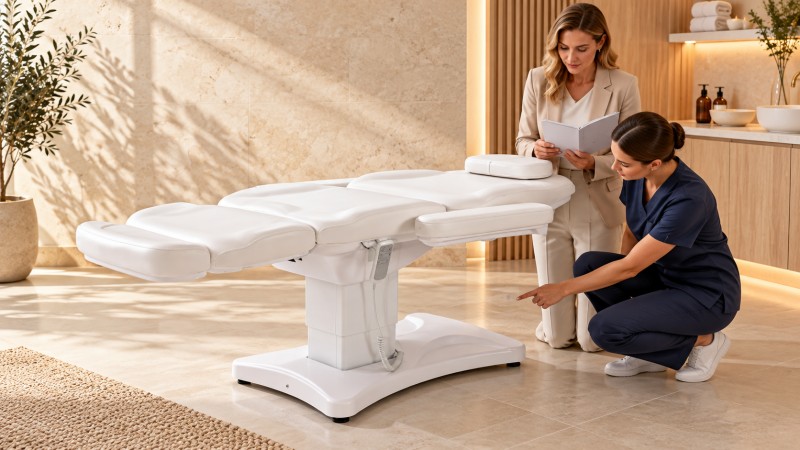
Working load and static load checks for a professional beauty bed
A beauty bed described as supporting 200 kg does not necessarily have the same usable capacity as another bed advertised with the same number. One supplier may be stating a maximum user weight. Another may be reporting a static test with the load spread evenly over a flat surface. A third may mean the total load permitted during normal operation. Unless the rating name and test conditions are clear, the number alone is incomplete.
For a professional buyer, the most useful figure is the load allowed during the treatments, transfers and adjustments the bed is actually expected to perform. Static-load results can provide useful evidence of structural strength, but they should not be substituted for a working-load or maximum-user rating.
This guide explains the terminology, the questions to put in an RFQ and the checks to complete before a beauty bed enters service.
Static load normally describes a stationary test load applied under defined conditions, often with the bed flat and the load distributed across the main surface. Working load describes the load allowed during intended use and may account for the client, practitioner-applied pressure and movement. Safe working load, maximum user weight, rated bearing and weight capacity are related terms, but they are not automatically interchangeable.
For purchasing purposes:
· do not choose a bed from the largest number shown in an advertisement;
· ask what the number includes and whether the bed may move while carrying it;
· confirm whether the load must be evenly distributed;
· obtain limits for the backrest, seat, leg section, extensions and armrests; and
· put the agreed rating and conditions into the quotation, purchase order and operating manual.
There is no universal conversion that turns a static-load result into a safe working load for every beauty bed. Use only the manufacturer’s documented rating for the exact model and configuration.
A static load is applied while the equipment and load remain stationary. The test may be designed to assess whether the frame, top, base or fasteners withstand a specified force without structural failure or unacceptable deformation.
The important words are *under defined conditions*. A result may apply only when the bed is flat, fully lowered, locked and loaded evenly over the main cushion. It may not describe client entry, raising the bed, reclining a section or applying treatment pressure.
In massage and treatment-table literature, working load commonly means the total load that the table can accept during its intended service. This can include the client’s mass and additional force applied by the practitioner. Earthlite, for example, distinguishes working weight from static weight and describes working weight as the more relevant measure for active treatment. That definition is useful, but it does not automatically define another manufacturer’s specification.
Safe working load, often abbreviated as SWL, is a controlled-use limit stated by the manufacturer. Its precise composition depends on the equipment category and the applicable documentation. In medical-bed standards, SWL can include the patient, mattress and accessories, while maximum patient weight is a separate value. A salon beauty bed is not automatically a medical bed, so buyers should not apply a medical-bed definition unless the product’s intended use, technical file and applicable standard support it.
Maximum user weight normally refers to the person on the bed rather than every load acting on it. It may exclude accessories, bolsters, bedding or practitioner pressure. If a brochure gives only this figure, ask whether the product’s rated operating load is different.
These are common product-page terms, but the label alone does not tell the buyer whether the value is static, dynamic, distributed, sectional or operational. The supplier should define the term in the manual or specification schedule.
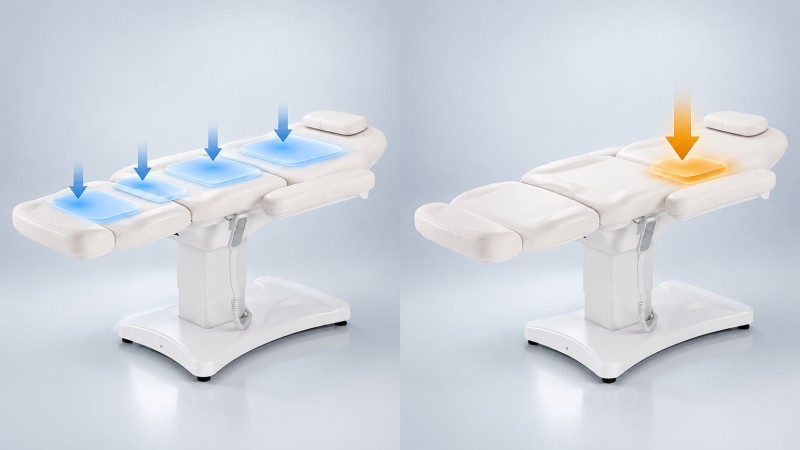
Distributed static load compared with concentrated loading on a beauty bed
A client lying centrally across the seat, backrest and leg section creates a different load path from a client sitting on one edge while getting onto the bed. The total mass may be identical, but the concentration of force and the resulting leverage are not.
This matters at several points:
· Seat edge: entry and exit can place most of the client’s weight on a small area away from the centreline.
· Raised backrest: the hinge, actuator and back section may have a lower sectional limit than the main seat.
· Leg extension: an extendable calf or foot section is not necessarily intended to carry a person’s full body weight.
· Armrests: removable or rotating armrests are usually positioning supports, not seats or transfer handles, unless the manual expressly says otherwise.
· Headrest: a removable head cushion or face cradle may have its own limit and should not be used as an entry point.
· Rotating top: an unlocked or partly locked swivel creates a stability question that is separate from vertical load capacity.
“Evenly distributed” is therefore not a minor footnote. It defines how the stated load reaches the frame and base.
A high static figure can be technically true and still be the wrong number for daily purchasing decisions. Static testing does not necessarily reproduce:
· a client lowering themselves quickly onto the edge;
· a practitioner applying repeated downward force;
· a bed moving from its lowest to highest position under load;
· a backrest or leg section changing angle;
· repeated cycles over several years;
· uneven floors, unlocked rotation or transport casters; or
· wear in pivots, fasteners, actuators and bushings.
Some massage-table manufacturers publish both static and maximum working weights, with the working figure lower than the static result. The relationship is model-specific. A ratio seen in one catalogue must not be applied to an unrelated electric or hydraulic bed.
The frame is only one part of an adjustable beauty bed. The usable rating may be constrained by the weakest relevant component or by the least favourable permitted position.
The base must resist vertical load, tipping and side forces. A wide pedestal can improve the footprint, but shape alone does not prove capacity or stability.
A mechanism may be able to hold a stationary load while having a lower rated lifting capacity. Ask whether the bed can raise and lower at the quoted capacity and whether the rating changes at maximum height.
Backrest and leg-rest limits may differ from the rating of the central seat. Sectional limits should be stated separately where misuse is foreseeable.
Armrests, headrests, extensions and accessories transfer force through smaller attachment points. Their safe use cannot be inferred from the capacity of the main frame.
Load capacity does not cancel an actuator’s duty cycle. Repeated adjustment without the required rest period can cause thermal protection to activate or shorten component life, even when the client is within the load rating.
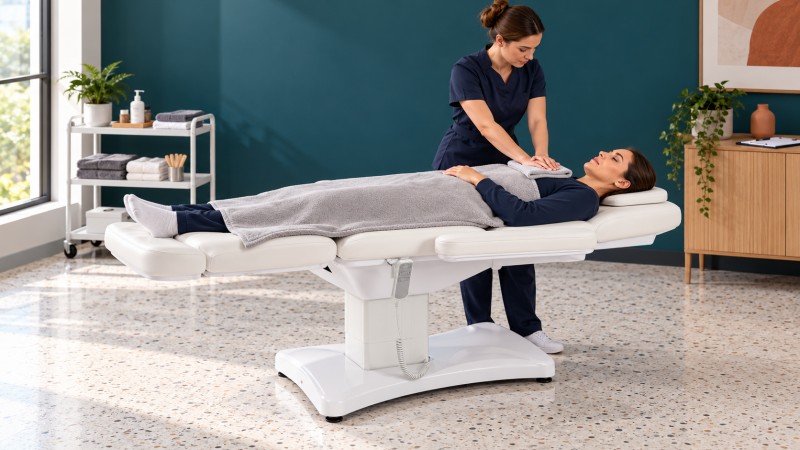
Working load includes the client and forces applied during a professional treatment
Use a load budget to frame the supplier discussion. It is not a substitute for the manufacturer’s rating or an engineering calculation.
Expected service load = client + approved accessories and supports + treatment forces accounted for by the manufacturer
Do not try to estimate practitioner force and then add an arbitrary safety percentage to a static figure. Instead, describe the service and ask the manufacturer to confirm that the working-load rating covers it.
For example, a facial room where the practitioner applies little pressure has a different load profile from a body-treatment room offering deep-pressure massage or assisted stretching. A lash bed may see limited treatment force but long appointments and frequent client entry from one side. A rotating medical-aesthetic chair may be used upright, tilted and flat, with different stability conditions in each position.
The purchasing specification should match the most demanding intended service, not the lightest service listed in the marketing copy.
The DP-L236 electric beauty bed currently lists a maximum weight capacity of 200 kg. That is useful for comparison, but the page does not by itself define every test condition a project buyer may need. A bulk purchaser should still request the applicable rating definition, permitted positions, sectional limits and test evidence for the quoted production version.
The DP-8194 electric beauty bed is listed with a 150 kg load capacity. Its available manual adds important context by identifying different limits for the main cushion and individual sections. That illustrates why a single product-page number should be read together with the operating manual.
When comparing the wider electric beauty bed range, record the rating terminology exactly as published. Do not silently rename “maximum load” as “safe working load” in a distributor catalogue unless the manufacturer confirms the equivalence.
Ask the supplier to answer the following for the exact model, voltage, base and accessory package:
1. What is the maximum user weight?
2. What is the rated working load or safe working load during intended treatment?
3. Does that load include bedding, bolsters and accessories?
4. Does the rating include pressure applied by the practitioner during the approved services?
5. Is the quoted static load different from the working load?
6. Was the test load evenly distributed, concentrated or applied in defined zones?
7. In which position was the bed tested: flat, lowest, highest, tilted or reclined?
8. Can every powered function operate at the stated working load?
9. Are there separate limits for the backrest, seat, leg rest, extensions, headrest and each armrest?
10. Does rotation need to be locked before the client gets on or off?
11. Must the levelling feet or casters be in a particular position?
12. Which test method or standard was used, and can the supplier provide the relevant report or declaration?
13. Does the rating apply to the production configuration being quoted, including OEM changes?
14. What inspection interval and replacement criteria apply to load-bearing components?
Use wording such as the following in the enquiry and purchase order:
State the maximum user weight, rated working load and static test load separately for the quoted model. Define what each value includes, the load distribution, bed position and whether all powered adjustments may operate at that load. Provide section-specific limits, the applicable test method, product labels and matching operating-manual pages. Ratings must apply to the final production configuration and included accessories.
This is clearer than asking only, “How many kilograms can the bed hold?”
The bed should not be selected so that the heaviest expected client sits exactly at an undefined “maximum load.” First establish whether the number is a user limit or a total operating limit. Then consider:
· the upper end of the client population;
· clothing, blankets, positioning cushions and approved accessories;
· the treatment technique and practitioner-applied force;
· side entry, transfers and other foreseeable loading patterns;
· the positions in which the bed will be used; and
· the organisation’s risk assessment and local requirements.
Do not publish a universal percentage as the correct safety margin. The appropriate choice depends on the manufacturer’s rating method, the service and the facility’s risk controls. If the supplier cannot define the rating, select a product with clearer documentation rather than inventing a margin around an ambiguous number.
Do not perform an improvised overload test in the salon. Acceptance testing should follow the manufacturer’s instructions and, where necessary, be completed by a qualified technician using an approved method.
At minimum:
1. Match the model, serial number, voltage and control configuration to the order.
2. Photograph the rating labels before the bed is placed in service.
3. Confirm that the manual uses the same rating terminology as the quotation.
4. Check that the bed stands level and every foot or approved floor contact is stable.
5. Lock the rotation, casters or transport mechanism as instructed.
6. Inspect welds, fasteners, hinges, pins, upholstery seams and accessory mounts.
7. Operate each adjustment unloaded and confirm its full path is clear.
8. Complete only the manufacturer-authorised functional load test.
9. Verify that unexpected noise, movement or drift does not occur.
10. Record the inspection, acceptance result and staff training date.
B2B acceptance check for beauty bed load ratings and documentation
Remove the bed from service and arrange inspection if staff observe:
· a new wobble, lean or uneven floor contact;
· cracked welds, loose structural fasteners or a distorted frame;
· sudden lowering, hydraulic drift or an actuator that will not hold position;
· grinding, popping or repeated clicking under normal load;
· a backrest, leg rest or extension moving beyond its normal play;
· a rotation lock or caster brake that no longer holds;
· a damaged power cable, handset, foot control or actuator lead; or
· a label or manual that no longer matches the installed configuration.
Do not solve a load-related symptom by tightening random fasteners, bypassing a control or increasing hydraulic pressure without an approved procedure.
It depends on the model and on what the manufacturer means by weight capacity. Current Dongpin product pages include examples rated at 150 kg and 200 kg, but buyers must confirm whether a figure is a maximum user weight, working load or another defined rating.
No. Static load normally refers to a stationary test under defined conditions. Maximum client weight should be stated separately or explicitly linked to that test by the manufacturer.
For daily service planning, a clearly defined working-load or maximum-user rating is usually more useful. Static testing remains valuable evidence of strength, but it does not automatically cover movement, adjustment or practitioner-applied pressure.
No universal four-to-one conversion applies to every beauty bed. Some manufacturers publish model-specific static and working figures with that relationship, but the frame, mechanism, test method and intended use differ between products.
Not necessarily. An actuator rating, thrust value or lift-column capacity is not the same as the rated capacity of the assembled bed. The structure, hinges, base, controls and stability must all be considered.
Only in the location and manner permitted by the manual. Edge sitting produces a concentrated and off-centre load. Staff should use the specified entry position and keep rotation or casters locked.
Do not assume so. Armrests and headrests may have much lower individual limits and may not be designed to support transfers, sitting or the practitioner’s weight.
Request the model-specific manual, rating labels, test method, relevant test report or declaration, section limits and written confirmation that the evidence applies to the final production configuration.
A credible beauty-bed rating is more than a kilogram figure. It identifies the type of load, what is included, where the load is applied, the bed position, whether the mechanism may move and which components have separate limits.
For B2B buyers, a clearly defined 150 kg working rating can be more useful than a much larger static claim with no test conditions. Write the definitions into the RFQ, verify them against the manual and labels, and commission the bed according to the approved procedure. That approach protects clients, gives staff clearer operating rules and makes quotations from different suppliers genuinely comparable


"*" indicates required fields


